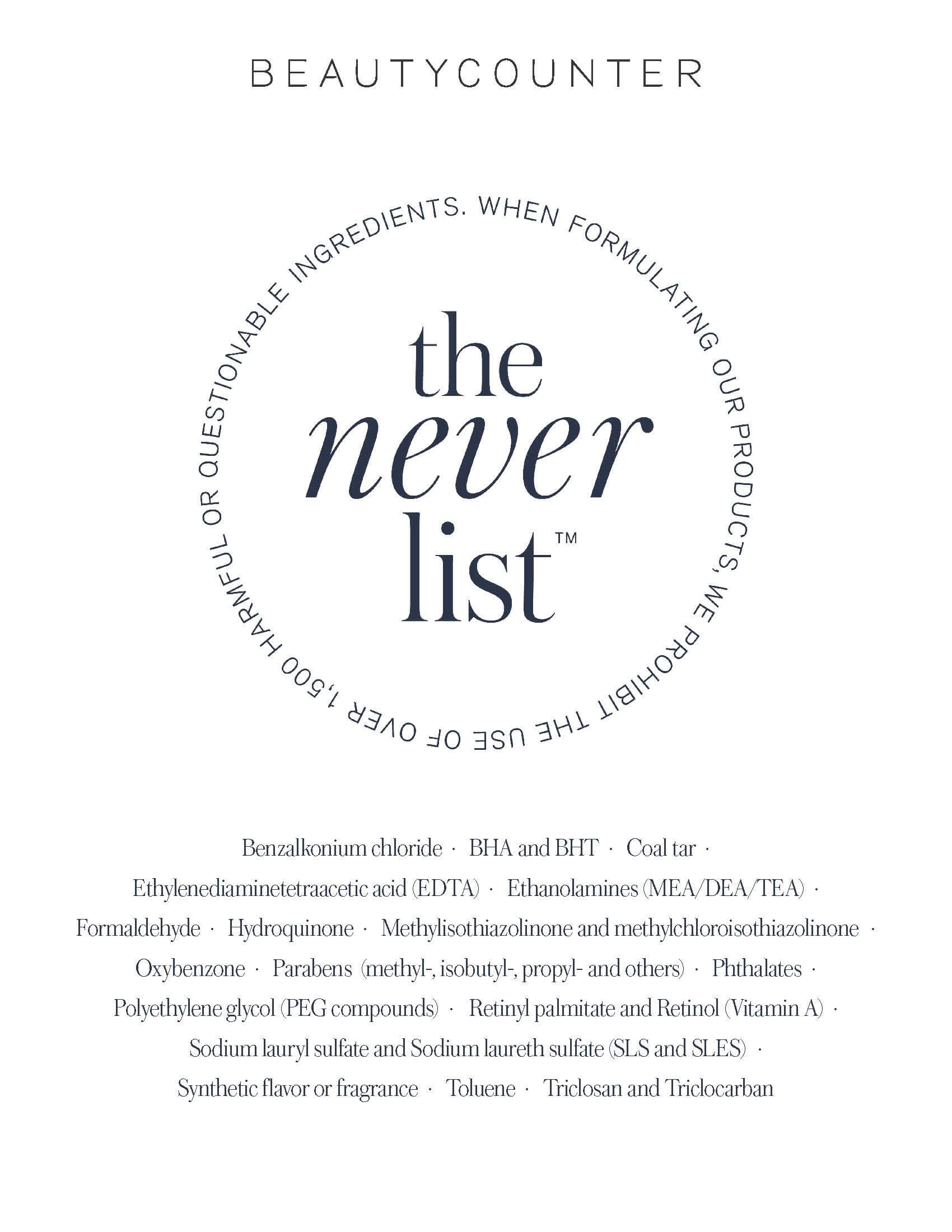

The Never List [Understanding Harmful Ingredients in Personal Care Products]

Sharing is caring!

Today I’m sharing an amazing resource, The Never List.

This article was originally published in 2017. At the time, I was working with Beautycounter (no longer in existence; now called Counter). It has been updated in 2026 to reflect current research, sources, and my personal skincare philosophy.


For years, I struggled with Perioral Dermatitis and various skin issues that left me frustrated and searching for answers.

What I discovered changed everything: the products I was putting on my body were just as important as what I was putting in it.

If you’ve been following my gut healing journey, you know I’m all about the gut-skin-hormone connection.

But here’s what surprised me: we obsess over every ingredient that goes into our mouths, yet rarely think twice about what we’re slathering on our skin multiple times a day.

Related articles you might find helpful:

  1. How I Healed My Perioral Dermatitis Naturally
  2. Chemicals in Our Personal Care Products
  3. Replacing My Personal Care Products

Why This Matters: The Skin-Body Connection

I was listening to a Better Everyday podcast with Sarah and Dr. Trevor Holly Cates when something clicked. Dr. Cates mentioned how we’re warned not to put certain things on our skin because they’d seep into our system so quickly.

Then she asked the question that changed my entire approach to skincare:

Then why do we allow everyday skin and body care products to be filled with chemicals and unsafe ingredients?

That hit me hard.

Here I was, meticulously tracking every food that touched my lips for healing purposes, while using conventional products loaded with questionable ingredients on my skin every single day.

What follows is a comprehensive breakdown of ingredients that can cause harm.

This isn’t about fear-mongering; it’s about making informed choices.

As I always say: “How can I live better today?”

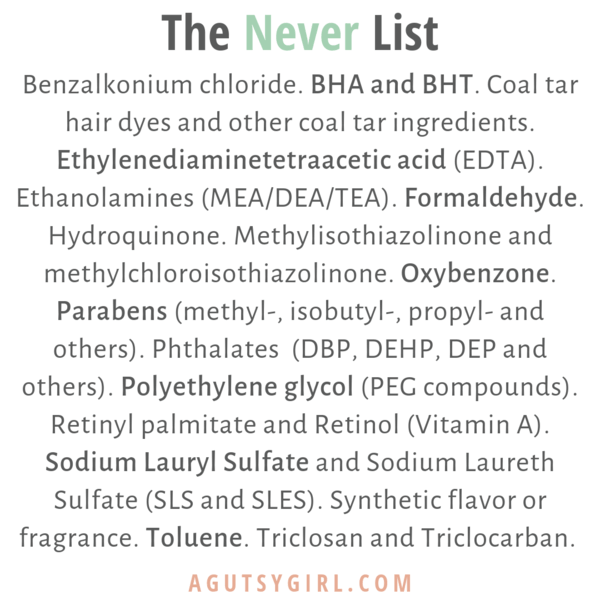
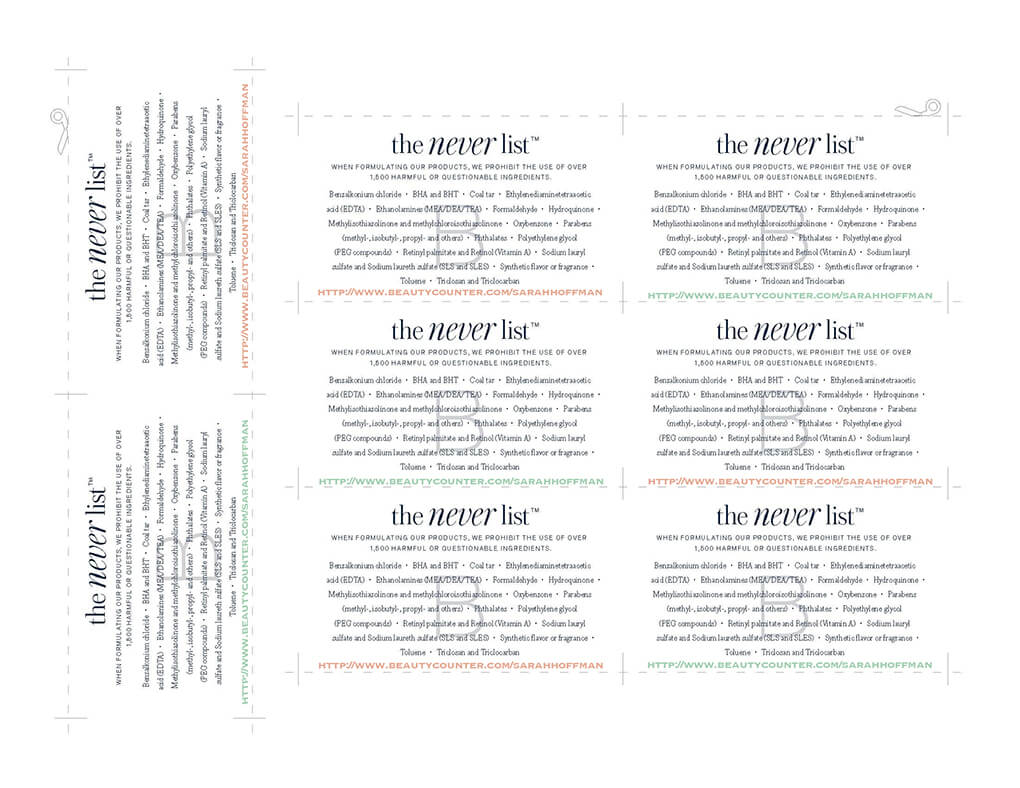
The Never List: Ingredients to Avoid

Click HERE to save this list for later.
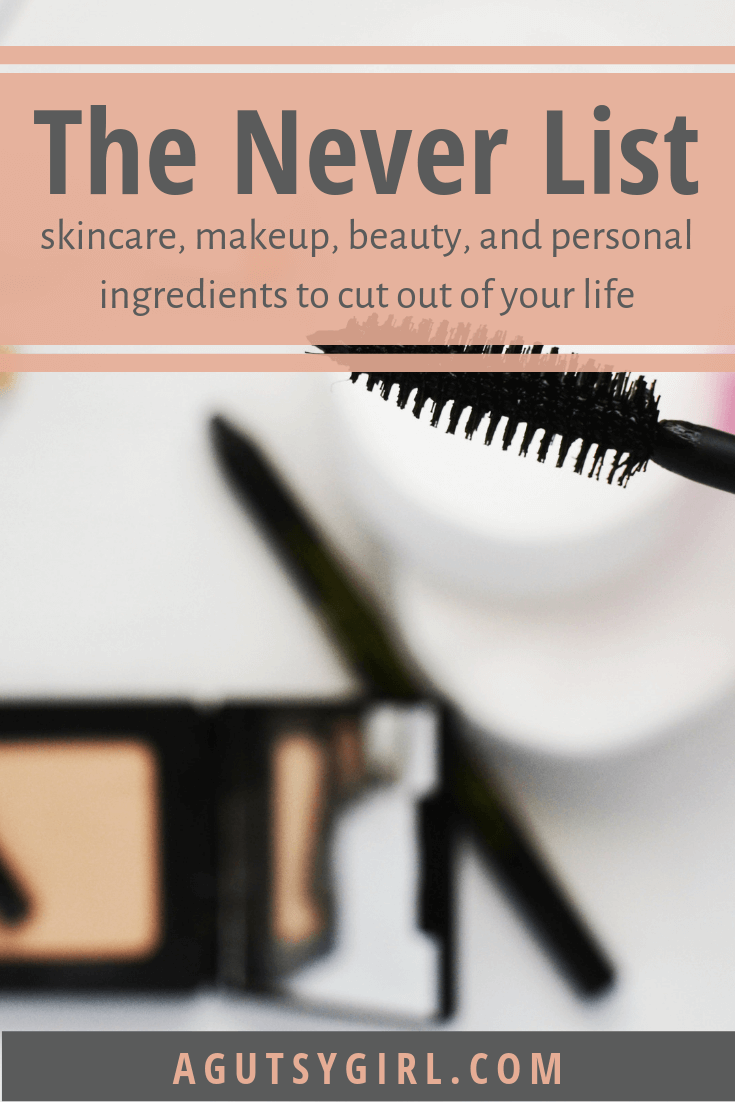
The Never List from the original Beautycounter agutsygirl.com

Benzalkonium Chloride

What it is: A quaternary ammonium compound used as a disinfectant, preservative, and surfactant in personal care products.

Why it’s concerning: Studies have linked benzalkonium chloride to severe skin, eye, and respiratory irritation. Research published in the Journal of Allergy and Clinical Immunology found that this ingredient can trigger contact dermatitis and allergic sensitization, particularly with prolonged exposure (Basketter et al., 2019). The compound’s antimicrobial properties can also disrupt the skin’s natural microbiome.

Where you’ll find it: Sunscreens, moisturizers, hand sanitizers, facial cleansers

Source: Basketter, D., et al. (2019). “Skin sensitization to quaternary ammonium compounds.” Contact Dermatitis, 81(5), 303-310.


BHA (Butylated Hydroxyanisole) and BHT (Butylated Hydroxytoluene)

What they are: Synthetic antioxidants used to extend the shelf life of products by preventing oxidation.

Why they’re concerning: The National Toxicology Program classifies BHA as “reasonably anticipated to be a human carcinogen.”

Both BHA and BHT are suspected endocrine disruptors that may interfere with hormone function. Animal studies have shown potential for liver damage and thyroid problems (National Toxicology Program, 2021).

The European Commission on Endocrine Disruption has flagged both as priority substances for further investigation.

Where you’ll find them: Lipsticks, moisturizers, diaper creams, makeup, anti-aging serums

Source: National Toxicology Program. (2021). “14th Report on Carcinogens.” U.S. Department of Health and Human Services.


Coal Tar Hair Dyes and Other Coal Tar Ingredients

What it is: A thick, dark liquid byproduct of coal processing used as a colorant and anti-dandruff agent.

Why it’s concerning: Coal tar is a known human carcinogen according to the International Agency for Research on Cancer (IARC).

The polycyclic aromatic hydrocarbons (PAHs) in coal tar have been linked to increased cancer risk, particularly with long-term use. Research in Environmental Health Perspectives has documented DNA damage from coal tar exposure (Kim et al., 2018).

Where you’ll find it: Hair dyes (especially darker shades), anti-dandruff shampoos, psoriasis treatments

Source: Kim, K.H., et al. (2018). “Polycyclic aromatic hydrocarbons in coal tar-based products and risk assessment.” Environmental Health Perspectives, 126(10).


EDTA (Ethylenediaminetetraacetic Acid)

What it is: A chelating agent that binds to metal ions, used to improve product stability and preserve formulations.

Why it’s concerning: While EDTA itself has relatively low toxicity, studies published in Reproductive Toxicology suggest it may be toxic to organs at high concentrations (Lanigan & Yamarik, 2002).

More concerning is its persistence in the environment, where it doesn’t readily break down and can remobilize heavy metals. The compound may also enhance the absorption of other potentially harmful ingredients through the skin.

Where you’ll find it: Hair color products, moisturizers, facial cleansers, body washes

Source: Lanigan, R.S., & Yamarik, T.A. (2002). “Final report on the safety assessment of EDTA.” International Journal of Toxicology, 21(Suppl 2), 95-142.


Ethanolamines (MEA/DEA/TEA)

What they are: Compounds used as emulsifiers, pH adjusters, and foam-producing agents. MEA is monoethanolamine, DEA is diethanolamine, and TEA is triethanolamine.

Why they’re concerning: The European Commission’s Scientific Committee on Consumer Safety raised concerns about DEA’s potential to form carcinogenic nitrosamines when combined with certain preservatives.

Research has linked ethanolamines to allergic reactions, skin toxicity, hormone disruption, and potential impacts on fetal brain development (Nohynek et al., 2013). The FDA has flagged DEA-related ingredients as concerning.

Where you’ll find them: Hair dyes, mascara, foundation, fragrances, sunscreens, shampoos, soaps

Source: Nohynek, G.J., et al. (2013). “Benefit and risk of organic UV filters.” Regulatory Toxicology and Pharmacology, 33(3), 285-299.


Formaldehyde and Formaldehyde-Releasing Preservatives

What it is: A colorless, strong-smelling gas used as a preservative in cosmetics. Many ingredients release formaldehyde slowly over time.

Why it’s concerning: Formaldehyde is classified as a known human carcinogen by the IARC and the National Toxicology Program.

Exposure has been linked to nasopharyngeal cancer, leukemia, asthma, neurotoxicity, and developmental issues (National Cancer Institute, 2022). Even low-level exposure can cause skin irritation and allergic reactions.

Formaldehyde-releasing preservatives include:

  • Quaternium-15
  • DMDM hydantoin
  • Imidazolidinyl urea
  • Diazolidinyl urea
  • Sodium hydroxymethylglycinate
  • 2-bromo-2-nitropropane-1,3 diol (Bronopol)

Where you’ll find it: Shampoos, body washes, bubble baths, nail polishes, hair straightening treatments

Source: National Cancer Institute. (2022). “Formaldehyde and Cancer Risk.” U.S. Department of Health and Human Services.


Hydroquinone

What it is: A skin-bleaching chemical that works by decreasing the production of melanin pigment in the skin.

Why it’s concerning: The European Union banned hydroquinone in cosmetics in 2001 due to safety concerns. Studies have linked it to ochronosis (a skin condition causing blue-black discoloration), potential carcinogenicity, and organ toxicity (Desmedt et al., 2016).

It may also cause paradoxical darkening in some individuals and has been associated with mercury contamination in some products.

Where you’ll find it: Skin-lightening creams, dark spot correctors, anti-aging products (though increasingly restricted)

Source: Desmedt, B., et al. (2016). “Overview of skin whitening agents with an insight into the illegal cosmetic market in Europe.” Journal of the European Academy of Dermatology and Venereology, 30(6), 943-950.


Methylisothiazolinone (MI) and Methylchloroisothiazolinone (MCI)

What they are: Preservatives used to prevent bacterial and fungal growth in personal care products.

Why they’re concerning: These are among the most common causes of contact dermatitis from cosmetics. The American Contact Dermatitis Society named methylisothiazolinone its “Allergen of the Year” in 2013 (Lundov et al., 2013).

Studies show these preservatives can cause severe allergic reactions, even at low concentrations, and may persist on skin and in the environment.

Where you’ll find them: Shampoos, conditioners, body washes, lotions, makeup removers, wet wipes

Source: Lundov, M.D., et al. (2013). “Methylisothiazolinone contact allergy: a review.” British Journal of Dermatology, 169(6), 1287-1293.


Oxybenzone (Benzophenone-3)

What it is: A chemical UV filter commonly used in sunscreens to absorb UVB and short UVA rays.

Why it’s concerning: Research published in Reproductive Toxicology shows oxybenzone can act as an endocrine disruptor, interfering with hormone function (Krause et al., 2018). It’s been detected in breast milk, urine, and blood samples, indicating systemic absorption.

The ingredient has also been linked to coral reef damage, prompting bans in Hawaii and other locations. Studies suggest associations with reduced sperm quality and altered birth weights.

Where you’ll find it: Chemical sunscreens, moisturizers with SPF, lip balms, makeup

Source: Krause, M., et al. (2018). “Sunscreens: are they beneficial for health? An overview of endocrine disrupting properties of UV-filters.” International Journal of Andrology, 35(3), 424-436.


Parabens (Methyl-, Isobutyl-, Propyl-, and others)

What they are: A class of widely used preservatives that prevent the growth of bacteria and mold in cosmetics.

Why they’re concerning: Parabens can mimic estrogen in the body and have been detected in breast tissue samples, raising concerns about potential links to breast cancer (Darbre & Harvey, 2014). While the FDA states current levels are safe, accumulating research suggests parabens may disrupt the endocrine system, affect reproductive function, and alter thyroid hormone levels.

Their ubiquity means we’re exposed from multiple sources daily.

Where you’ll find them: Shampoos, face cleansers, body washes, body lotions, foundations, deodorants

Source: Darbre, P.D., & Harvey, P.W. (2014). “Parabens can enable hallmarks and characteristics of cancer in human breast epithelial cells.” Journal of Applied Toxicology, 34(9), 925-933.


Phthalates (DBP, DEHP, DEP, and others)

What they are: A class of plasticizing chemicals used to make products more pliable or to help fragrances last longer on skin.

Why they’re concerning: Multiple studies link phthalates to endocrine disruption, reproductive harm, and developmental issues.

Research in Environmental Health Perspectives documents associations with altered genital development in male infants, reduced sperm quality, premature breast development in girls, and increased risk of preterm birth (Swan et al., 2015).

Some phthalates are restricted in the EU but remain common in U.S. products.

Where you’ll find them: Products with “fragrance” or “parfum,” nail polishes, hairsprays, plastic packaging

Source: Swan, S.H., et al. (2015). “Decrease in anogenital distance among male infants with prenatal phthalate exposure.” Environmental Health Perspectives, 113(8), 1056-1061.


PEG Compounds (Polyethylene Glycols)

What they are: Petroleum-based compounds used as thickeners, solvents, softeners, and moisture carriers in cosmetics.

Why they’re concerning: While PEGs themselves may be relatively safe, the manufacturing process can create concerning contaminants. Studies show PEGs may be contaminated with ethylene oxide (a known carcinogen) and 1,4-dioxane (a probable carcinogen) (Cosmetic Ingredient Review, 2020).

These contaminants persist through the manufacturing process and into final products. PEGs can also enhance skin penetration of other ingredients, both beneficial and harmful.

Where you’ll find them: Creams, sunscreens, shampoos, conditioners, makeup removers

Source: Cosmetic Ingredient Review. (2020). “Safety Assessment of PEG/PPG Copolymers as Used in Cosmetics.”


Retinyl Palmitate and Retinol (Vitamin A)

What they are: Forms of vitamin A commonly added to anti-aging skincare products for their skin-renewing properties.

Why it’s concerning: While retinoids can be beneficial when used properly, research from the National Toxicology Program suggests that retinyl palmitate may speed the development of skin tumors and lesions when applied to skin exposed to sunlight (NTP, 2012).

Studies also show these ingredients can cause photosensitivity, making skin more vulnerable to UV damage. Pregnant women are advised to avoid retinoids due to risk of birth defects.

Where you’ll find them: Anti-aging serums, moisturizers, eye creams, acne treatments

Source: National Toxicology Program. (2012). “Photocarcinogenesis Study of Retinoic Acid and Retinyl Palmitate.” Technical Report Series No. 568.


Sodium Lauryl Sulfate (SLS) and Sodium Laureth Sulfate (SLES)

What they are: Surfactants that create lather and help products clean by removing oils and dirt.

Why they’re concerning: Both can cause skin irritation, particularly in people with sensitive skin or conditions like eczema (Bondi et al., 2015). SLES is often contaminated with 1,4-dioxane, a byproduct of the ethoxylation process used to make it “gentler” than SLS.

This contaminant is a probable carcinogen that doesn’t appear on ingredient labels. Studies show these surfactants can disrupt the skin’s natural lipid barrier, leading to increased transepidermal water loss and irritation.

Where you’ll find them: Shampoos, body washes, bubble baths, facial cleansers, toothpaste

Source: Bondi, C.A., et al. (2015). “Human and Environmental Toxicity of Sodium Lauryl Sulfate (SLS).” Environmental Health Insights, 9, 27-32.


Synthetic Fragrance

What it is: An umbrella term that can hide any combination of 3,000+ chemical ingredients used to scent products.

Why it’s concerning: “Fragrance” or “parfum” on a label is a catch-all term protected as a trade secret, meaning companies don’t have to disclose what’s in it. Research shows fragrance mixtures commonly contain phthalates, synthetic musks, and other allergens (Steinemann, 2019).

Studies link fragrance chemicals to allergic reactions, respiratory issues, hormone disruption, and neurological effects. The International Fragrance Association lists over 3,000 ingredients that could be hiding under this single word.

Where you’ll find it: Virtually all types of cosmetics, lotions, perfumes, hair products, cleaning products

Source: Steinemann, A. (2019). “International prevalence of fragrance sensitivity.” Air Quality, Atmosphere & Health, 12(8), 891-897.


Toluene

What it is: A volatile petrochemical solvent derived from petroleum or coal tar, used to dissolve other substances and improve application.

Why it’s concerning: The EPA classifies toluene as a toxic substance. Studies show it can affect the central nervous system, causing symptoms like dizziness, headaches, and confusion (Agency for Toxic Substances and Disease Registry, 2017).

Chronic exposure is linked to reproductive harm, developmental issues in fetuses, and immune system toxicity. Nail salon workers face particular risk from repeated exposure.

Where you’ll find it: Nail polishes, nail treatments, hair dyes

Source: Agency for Toxic Substances and Disease Registry. (2017). “Toxicological Profile for Toluene.” U.S. Department of Health and Human Services.


Triclosan and Triclocarban

What they are: Antimicrobial pesticides added to consumer products to kill bacteria and fungi.

Why they’re concerning: The FDA banned triclosan from antibacterial soaps in 2016 due to concerns about hormone disruption, antibiotic resistance, and environmental harm (FDA, 2016). Research shows these chemicals accumulate in aquatic environments and are toxic to algae and fish.

Studies link them to thyroid hormone disruption, altered gut microbiome, and contribution to antibiotic-resistant bacteria. They’re also suspected endocrine disruptors that may interfere with muscle function.

Where you’ll find them: Liquid hand soaps (less common since FDA ban), bar soaps, toothpaste, deodorants, some cosmetics

Source: U.S. Food and Drug Administration. (2016). “FDA issues final rule on safety and effectiveness of antibacterial soaps.”


Making the Switch: Why I Chose Herbal Face Food

After years of researching ingredients and testing countless products, I discovered Herbal Face Food and haven’t looked back.

Here’s why this line aligns perfectly with my gut health philosophy and my approach to healing:

Clean, Transparent Ingredients Every single ingredient in Herbal Face Food products is listed clearly, nothing hiding behind “fragrance” or proprietary blends. When you’re healing from the inside out, you need to know exactly what you’re putting on your largest organ.

The Gut-Skin Connection Just as I focus on reducing inflammation through diet, Herbal Face Food formulations work to reduce skin inflammation topically. Their products support the skin’s microbiome rather than stripping it, which mirrors my approach to gut health where we feed beneficial bacteria rather than eliminating everything.

Zero Never List Ingredients Unlike even some “natural” brands that sneak in a preservative or two from the Never List, Herbal Face Food contains NONE of the ingredients discussed above. Not a single one. This isn’t marketing; it’s their actual formulation philosophy.

Supports Your Healing Journey When you’re dealing with gut issues, skin problems, or hormonal imbalances (all connected, remember), the last thing you need is to add more hormone-disrupting chemicals to the mix. Using truly clean skincare removes one more burden on your system.


The Bottom Line: Knowledge Over Fear

Look, will using one of these ingredients occasionally cause harm? Probably not.

But here’s the thing: we’re not using them occasionally. We use multiple products every day, each containing multiple potentially harmful ingredients. This adds up to a significant body burden over time.

My approach has never been about perfection or inducing fear.

It’s about making informed choices that support your overall healing journey.

When I was healing my gut, I learned that “This is never forever. It’s simply a bridge.” The same applies to clean beauty.

The more we know, the better our decisions can be.

Instead of thinking “I have to die someday,” I choose to think: “How can I live better today?”

For me, that means choosing products I trust, from companies that prioritize transparency, and that align with my gut-healing philosophy.

It means reading labels, asking questions, and making choices that reduce my toxic load rather than add to it.

Your skin deserves the same care and attention you’re giving your gut.


Frequently Asked Questions

Q: Are “natural” or “organic” products automatically safer? A: Not necessarily. These terms aren’t well-regulated in personal care. Some natural ingredients can still be irritating or allergenic. Focus on specific ingredients rather than marketing terms.

Q: How do I transition to cleaner products? A: Start with products you use most frequently or leave on longest (moisturizer, sunscreen). Replace items as they run out rather than doing everything at once. Check the EWG Skin Deep database for product safety ratings.

Q: Are these ingredients banned in other countries? A: The EU has banned over 1,300 specific ingredients in cosmetics through its Cosmetics Regulation (EC) No 1223/2009, while the U.S. FDA has only prohibited or restricted approximately 11 categories of substances—totaling fewer than 40 individual ingredients (European Commission, 2009; FDA, 2023).

Q: Will clean products work as well? A: In my experience, yes! It may take a brief adjustment period, but clean formulations can be just as effective. Some might argue they’re even better since they work with your skin rather than stripping it.

Q: How does skincare relate to gut health? A: The gut-skin axis is well-documented in research. Inflammation, hormone disruption, and toxic burden from skincare can impact gut health, just as gut health affects skin appearance. Reducing toxic load from all sources supports overall healing. [Read: Why I Use Herbal Face Food for Sensitive, Reactive Skin]


If you liked this article, you might also enjoy:

  1. The Complete Herbal Face Food FAQ: Your Questions Answered
  2. Herbal Face Food The Soap: A Luxurious Daily Cleanse That Actually Lasts
  3. Why I’m Recommending Herbal Face Food (And Why You Should Try It)

Xox,
SKH

Affiliate disclosure: The Herbal Face Food products and links in this post are affiliates. When you purchase anything from Herbal Face Food, you will save a hefty amount and I make a small commission. This is part of my business that helps keep this website afloat for me to bring you the information for free. And I’m so grateful for you.

Similar Posts

9 Comments

  1. Hi Sarah I also have major breakouts as u have and it’s so hard to find good products but with u sharing with us the info it’s a real help I too have done major research on everything as I have five autoimmune disorders. Not easy but knowledge is power and I’m really learn ii ng a lot from your book I got last week. I’ve have been dealing with autoimmune disorders since 94 so the more we can earn the better we all r off and having u doing what u do helps us as well so thanks for that.

Leave a Reply

Your email address will not be published. Required fields are marked *