

Supplement fatigue. Are you there yet? Me, too. I have your minimalist approach to gut healing supplements today.
After all, we are in the era of minimalism – thank you very much Marie Kondo.
I got this private message on Instagram, so I knew that now was for sure the time to address it.
Quick question! I see you showing and talking about a lot of probiotic supplements or other products. Why do we need to take these things? Shouldn’t our bodies have enough of this naturally and with proper nutrition? Taking additional pills and/or other products seems so unnatural. Also, thank you for all the inspo on your channel!
Love this question and these honest thoughts so much. The Gutsy ‘gram community is phenomenal!
Why Supplement in the First Place?
In theory, our bodies have enough of all the right things and no supplementation is needed.
While the body is extremely intelligent and capable of knowing what and how to get what it needs, these days there are gaps in our diets and illness which can cause damage needing re-building.
Nutritionally, HERE is what you need on a daily basis. This is how the majority of people supplement – to fill in the gaps of where they might not be getting enough nutrition from food.
But supplements extend far beyond the multivitamin or a general dose of Vitamin C.
The global dietary supplements market is expected to reach USD 278.02 billion by 2024. This includes:
- Botanicals
- Vitamins
- Minerals
- Amino Acids
- Enzymes
- Others
And the reason so much supplementation occurs is because:
- SAD – Standard American Diet
- Soil depletion
- Water depletion
- Low-Calorie diets are low nutrient diets
- Fewer nutrients from poor quality foods (non-organic)
- Grain-fed meat and conventional dairy
- Toxin exposure
- Nutrient absorption declines with age
- Exercise increases nutrient needs
- Supplementation may help you live longer
- Expense and health
We also have to consider this:
Or is the real reason we supplement so much due to marketing?
My honest opinion? Both. Some of us need to supplement, but some of the supplementation we’re doing is unwarranted – due maybe more to marketing than anything else.
Are you Supplementing Due to Marketing or Need?
Click HERE to save this graphic for later.
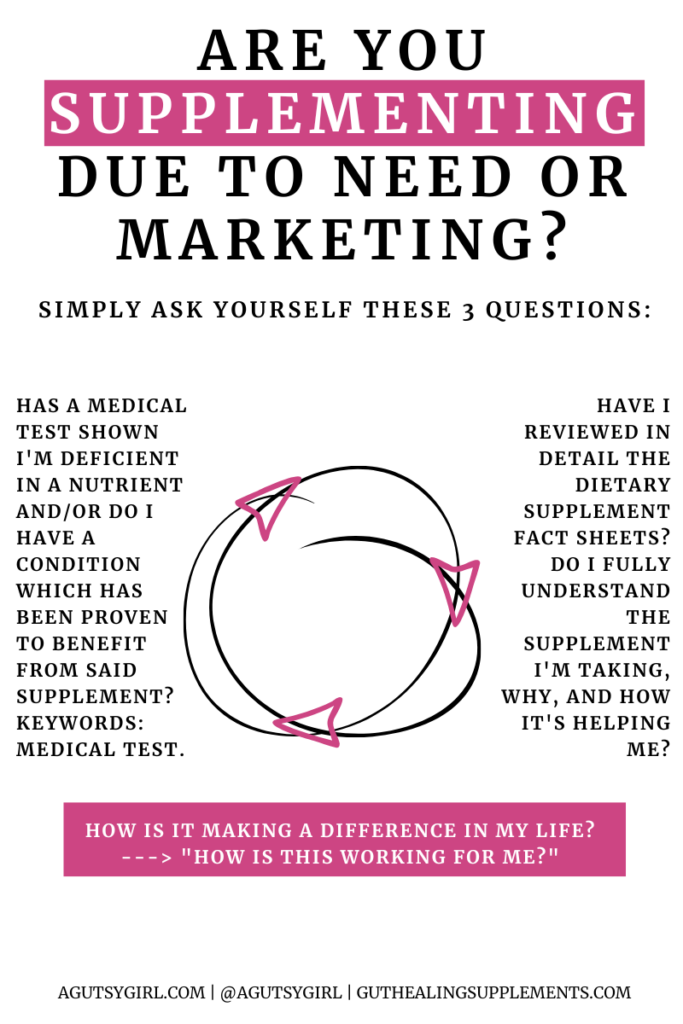
It’s very easy to determine which category you fit under: marketing or need.
You simply ask yourself these three questions:
- Has a medical test shown I’m deficient in a nutrient and/or do I have a condition which has been proven to benefit from said supplement? Keywords: medical test.
- Have I reviewed in detail the Dietary Supplement Fact Sheets? Do I fully understand the supplement I’m taking, why, and how it’s helping me?
- How is it making a difference in my life? —> “How is that working for you?” (p.s. Started doing this in 2014, which you can read about HERE.)
Which of the three do I think can be most useful for you today? Number three.
You’re taking 17 supplements, but you are still not feeling anywhere near well. Do you think the supplements are working?
You Need to Supplement (vs. Marketing)
You believe you need the supplement, but then there is still more drilling down that needs to happen.
Time for a story with supplement practical applications.
Marco Polo is the best ever. My three BFF’s and I communicate on it daily. When we wake up, we share about the day ahead and at the end of the day, we recap our days. It’s such an awesome way to feel connected to them as people, friends, and moms.
Well yesterday, one sent us a message, “…..and now we have a mouse in the house, in addition to our ant problem.”
Another friend responded, “If I can give you one piece of advice, it would be to use peanut butter vs. cheese on the trap. They have to work harder to get it, which means you’ll more likely catch them.”
To which the first friend responded, “We actually did that. But what happened? No mouse. The ants were all attracted to the trap and now we have more of them.”
Both friends had the same problem and same end goal, but the approach perhaps should not have been the same. One had an ant and mouse problem; the other, just a mouse problem.
This is like supplements. Just because your friend is taking a probiotic because her stomach is off from a round of antibiotics doesn’t mean that the same probiotic will work for you – you who has an off stomach, SIBO-specific, and Hashimotos.
Make sense?!
Now, I’m going to give you my minimalist approach to gut healing supplements.
Minimalist Approach to Gut Healing Supplements
Click HERE to save this post for later.
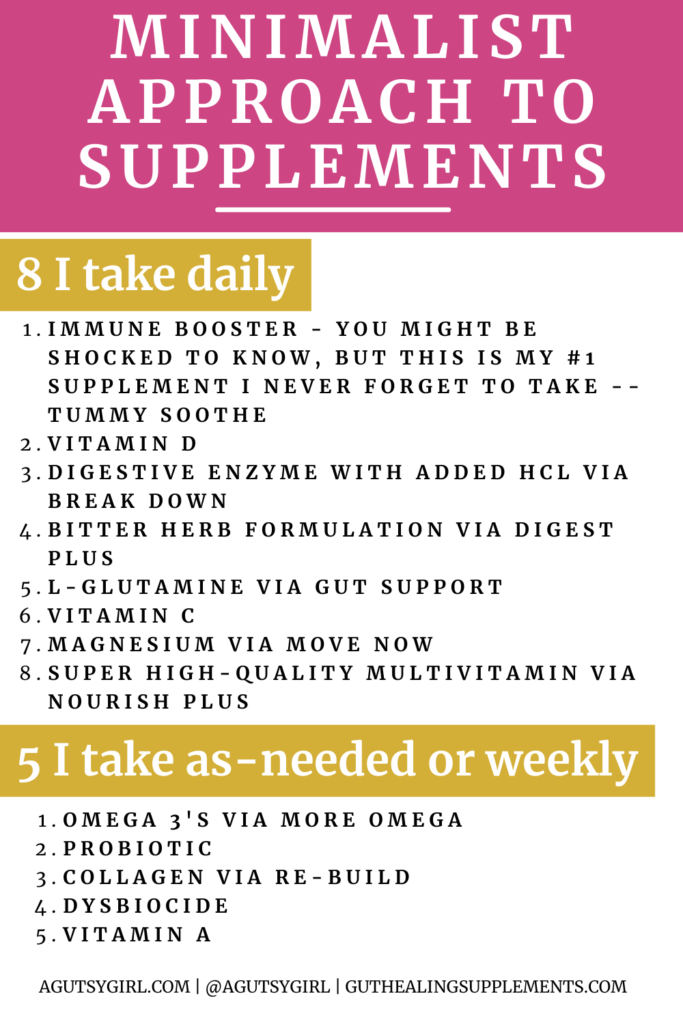
Yes, yes I have taken all of these Recommended Supplements at one point or another. If I didn’t, I wouldn’t recommend them. But I’m far from taking them all (or even that many) today.
There have been points in my life when I have felt like supplementing was a part-time job because it was. And it was exhausting. Maybe more than the time effort is the fact that I look back and think, “But did it all help?”
I’m not sure. Even if it did help, what helped?
There are two main reasons I take a minimalist approach to gut healing supplements today:
- Cost. A friend told me yesterday that her functional practitioner had her on about $600 worth of supplements. Sounds about right. If you think you need them all and are seeing benefits, you might have to spend the money and go through the motions (even for a short while). But I’d encourage you to go back to my above three statements about a true need or simply marketing and ask yourself question number three. (Remember, even a functional practitioner makes money when you purchase supplements at their office.)
- What’s working? If you are taking all the supplements, all the time, then how can you really be certain of which are working or are not working? You can’t.
Super Supplements
Every single person is different, but for me, today, I take just eight daily supplements religiously. They are:
- Immune Booster – you might be shocked to know, but THIS is my #1 supplement I never forget to take — Tummy Soothe
- Vitamin D
- Digestive Enzyme with added HCL via Break Down
- Bitter Herb formulation via Digest Plus
- L-Glutamine via Gut Support (coming soon!)
- Vitamin C
- Magnesium via Move Now
- Super high-quality multivitamin via Nourish Plus
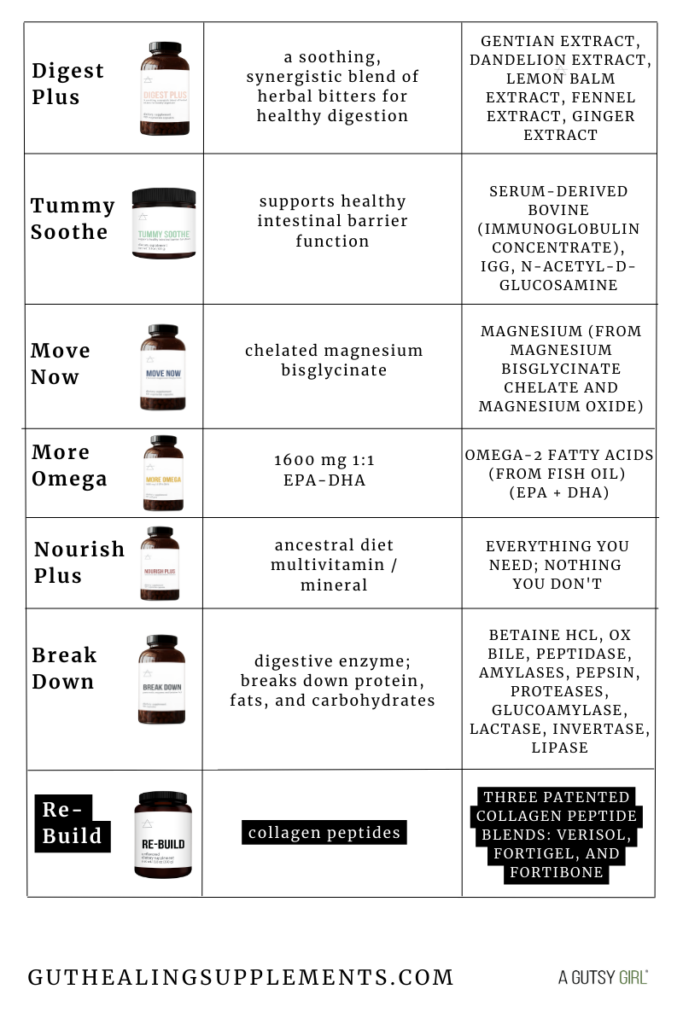
Get any of my SUPER supplements on the Minimalist list + save 15% at checkout with code BLOG.
Now, I know what you might be thinking – 8 is not minimal.
But for me it is, considering the fact that I used to double that.
And also, of the above, 3 of them are in powder form so they are super easy to add into food or beverages I’m already consuming.
And then, off and on, as needed or every few days (because remember, once you take the minimalist approach to gut healing supplements you’ll know more about what you need and don’t at any given moment):
- Omega 3’s via More Omega
- Probiotic
- Collagen via Re-Build
- Dysbiocide
- Vitamin A
BTW – how did I arrive at my minimalist cocktail?
I kept a tight journal for what was and what was not working. It’s actually fairly simple.
While I now take a minimalist approach to gut healing supplements (and believe you should do the same), I’ll continue sharing all about different supplements, all the time – whether or not I take them.
Why? Go back to my peanut butter, ants, and mice analogy. The supplements on my list above might be completely irrelevant for you, but something like Adrenal Glandular (which I no longer currently need) might be very relevant.
The goal is to provide any and all information possible, and then leave the decision up to you (+ your doctor).
Questions? Also, I’m always up for investigating new supplements – leave your requests in the comments below.
If you liked this post, you might also enjoy:
Xox,
SKH

🤰 bloating be gone! weight loss through optimal gut health for women
💃ʜᴇᴀʟ ʏᴏᴜʀ ɢᴜᴛ. ʜᴇᴀʟ ʏᴏᴜʀ ʟɪfe.
🫶🏻 founder gutbyome.com




Hi! Thanks for all your info. Can you explain why you take the supplements you take? I have Crohns and was taking digestive enzymes until I got the diagnosis – I assume you only need these enzymes if you lack them (which is not the case for someone with crohns). Do you lack these enzymes? Why HCL? Was there a test you took that showed you were deficient in stomach acid? Is that a test we should all be taking? Re L-Glutamine – the reviews of the one you use mention having to take it on an empty stomach (one reviewer says to mix it up and leave it by your bed and drink it when you wake up in the night to pee) – do you do that? And do you take 5mg as per the bottle or 10mg as some reviewers suggest…? Many, many thanks!
I’m curious if you’re still taking LDN?
I am. I might forever, too.