

I’m going to show you how to stock a healthy pantry, one that works for a regular Tuesday night and for the week the power goes out.
Updated September 2026
The short answer
To stock a healthy pantry, start with the foods you actually use each week, then build categories: grains and beans, canned goods, nuts and seeds, oils and vinegars, baking staples, and a few real snacks. Buy staples in bulk, store them in labeled jars, keep canned goods below 85°F, and rotate older items forward.
Because there’s no point in having a prepared pantry if it’s only filled with junk.
If disaster strikes and you have to live off that pantry, you want food that lets you actually function.
Click HERE to save this post for later.

What is a pantry?
A pantry is a cupboard, closet, or small room for shelf-stable food and kitchen supplies: the dry goods, cans, oils, and staples you reach for most.
The word started with bread. “Pantry” comes from the Anglo-French panetrie, originally “a storeroom or closet, especially for bread,” from the Latin panis, meaning bread. (Source)
If I had a nickel for every time someone asked me how we eat, and how I get my kids to eat the same way, I’d be set for life.
There are few places in our house I love more than the pantry.
When we moved into our California house years ago, the pantry was the “room” I was most excited about. I had never had a separate space, door and all, just for pantry items.
That’s where I got good at this.
7 tips for stocking a healthy pantry
Click HERE to save these tips for later.
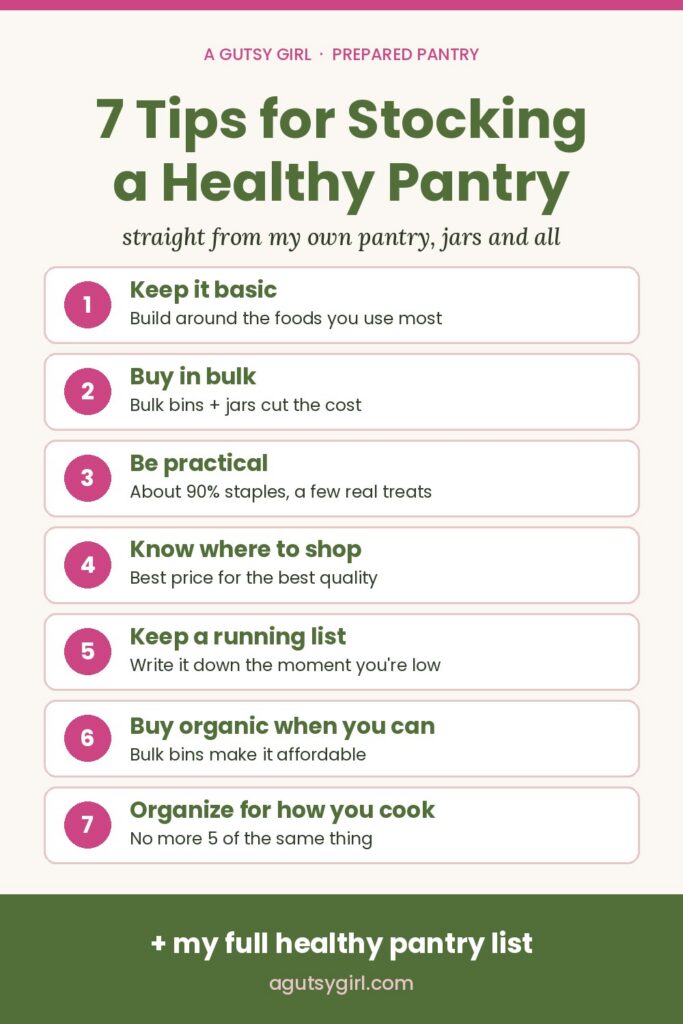
1. Keep it basic
Your pantry holds the food you use most often. If it’s a separate room, it’s also where the overflow goes.
No matter the size, you want everything necessary to fit. The easiest way to do that is to keep it basic.
I keep a list of the things I use most often and build the pantry around that list.
2. Buy in bulk
I buy a ton from bulk bins, then transfer everything into jars.
It cuts costs. And it lets me try things I might not buy in a full-size package.
3. Be practical
Yes, you’ll find snacks and treats in our pantry. But about 90% of what’s in there is basic and practical: rice, beans, oats, oils, cans.
4. Know where to get the best deal
You can stock a healthy pantry just by doing a little research on local and online grocery stores.
I shop several places because I know which one has the best price for the highest quality on each item. Online memberships like Thrive Market can help on organic pantry goods if you don’t have great bulk bins near you.
5. Keep a notepad (or a note on your phone)
Keep a notepad inside or next to the pantry and write items down the moment you’re getting low.
It’s not fun to plan rice for dinner, walk into the pantry, and find 1/4 cup of white rice left. Nope. Not pleasant.
If you use my journal, you can pair it with your pantry list.
6. Buy organic when you can
This matters to me, but you can stock a healthy pantry without going fully organic.
The reason I buy organic so often is that most of it comes from bulk bins, which saves a lot of money. (Almost everything on my list below that I buy in bulk is organic.)
7. Organize for how you cook
Type A over here. But if you organize your pantry around how you cook and bake day to day, you’ll keep track of things much better.
You won’t buy things you don’t need. You won’t end up with 5 of the same thing. And you’ll grab what you need in seconds.
How to store pantry food so it lasts
A stocked pantry only helps if the food is still good when you need it.
- Keep it cool and dry. The USDA says to store canned and shelf-stable food in a cool, dry place, away from the stove, the sink, and damp garages or basements. Temperatures below 85°F are best. (USDA)
- Know your can timelines. High-acid canned foods (tomatoes, fruit, pumpkin) keep 12 to 18 months. Low-acid canned foods (beans, vegetables, fish) keep 2 to 5 years. (USDA)
- Toss bad cans. A small dent is usually fine. Deeply dented, rusted, leaking, or bulging cans go in the trash.
- Rotate. New items go to the back, older items move to the front.
- Chill the fats. Nuts, seeds, and nut flours go rancid faster than grains. I keep extras in the fridge or freezer and only a jar’s worth in the pantry.
Stocking a pantry for emergencies
Ready.gov recommends storing at least a several-day supply of non-perishable food, choosing foods your family will actually eat, and planning for any special dietary needs. (Ready.gov)
That last part is the one people skip.
If you have gut issues, an emergency is not the week to be stuck with foods that flare you. Stock your safe foods first: the rice, the canned fish, the oats, whatever you know your gut tolerates.
A prepared pantry for a sensitive gut is built on your safe foods, not someone else’s list.
Not sure what your safe foods are yet? Start with my Elimination Diet Food List [Phase 1].
What’s in my healthy pantry (the full list)
I separate everything into categories. Mine might not be “normal” for your family, and that’s fine. The point is that categories help you find things. Figure out your own and this gets much easier.
Here’s a snapshot of our pantry. It changes from time to time.
| Category | Healthy pantry staples |
|---|---|
| Grains and beans | Gluten-free rolled oats, white rice, brown rice, quinoa, lentils |
| Canned goods | Beans, wild-caught sardines and tuna, tomato paste, pumpkin, olives |
| Oils and vinegars | Coconut oil, olive oil, avocado oil, apple cider vinegar |
| Nuts and seeds | Almonds, pecans, walnuts, pumpkin seeds, chia seeds, hemp seeds |
| Baking | Almond meal, coconut flour, arrowroot, coconut sugar, baking soda, cacao powder |
| Protein and support | Protein powder, collagen, gelatin, nutritional yeast |
| Snacks | Tortilla chips, coconut chips, ginger chews, a few real treats |
And here’s the detailed version, some brands included.
Beverages
- Sparkling Water
- Coconut water
- Organic Unsweetened Vanilla Almond Milk
- Coconut Milk (Aroy-D, Golden Star)
Snacks
People are surprised this category exists in our pantry.
But yes, yes, yes, of course it does!
Most of these live in one basket. We don’t eat them at every meal, and I don’t believe in shaming snack foods.
Besides, yum!
- Unreal Candy Coated Milk Chocolates (we’ve made Monster Cookies with these almost weekly)
- Various Made in Nature snacks
- Chimes Ginger Chews
- Back to Nature Organic Cookies
- Kirkland Organic Tortilla Chips
- Coconut chips
Oils and vinegars
- Nutiva Organic Coconut Oil (yes, we really keep a gallon of it in the house at all times)
- Bragg Organic Apple Cider Vinegar
- Olive oil
- Nutiva Organic Hemp Oil
- Avocado oil
- Nutiva Organic Buttery Coconut Oil
- Red wine vinegar
- White balsamic vinegar
- White wine vinegar
- Dry sherry
Canned goods
- Water chestnuts
- Kidney beans
- Lima beans
- Garbanzo beans
- Black beans
- Lentils
- Butter beans
- Olives
- Wild Caught Sardines
- Wild albacore tuna
- Capers
- Tomato paste
- Organic, diced tomatoes
- Pumpkin
- Annie’s Organic Tomato Soup
Protein powder
- Organic, Low-FODMAP Protein Powder
- Collagen
- Truvani Protein Powder, all and any flavors – it’s so good!
Baking
- Raw almond meal
- Pure cane sugar
- Fleur de Sel
- Nutiva Organic Shortening (this never has to be refrigerated, even after opening, and it’s vegan)
- Nutiva Organic Coconut Flour
- Wholesome Organic Powdered Sugar
- Nutiva Organic Coconut Sugar
- Bob’s Red Mill Arrowroot
- Anthony’s Organic Ginger
- Baking soda
- King Arthur 100% Organic All-Purpose Flour
- Shredded coconut
- Baking powder
- Extracts
- Cacao nibs
- Cacao powder
Nuts and seeds
- Raw pecans
- Raw almonds
- Raisins
- Cashews
- Walnuts
- Pumpkin seeds
- Hemp seeds
- Filberts
- Brazil nuts
- Sunflower seeds
- Nutiva Organic Chia Seeds
- Ground flaxseed
Why so many nuts and seeds? Simple.
I use most of them in my homemade trail mix for kids. And I still practice seed cycling most of the time.
Nut butters
- Nutiva Organic Coconut Manna
- Homemade nut butters from A Loving Spoon, my nut butter recipe book
- Costco Organic Peanut Butter, plain
Grains and beans
- Gluten-free rolled oats
- White rice
- Quinoa
- Brown rice
- Freekeh
- Orange lentils
The amount of white rice we eat in our house is ridiculous.
It’s always a staple because it’s so versatile.
Nutritional support
- Gelatin
- L-Glutamine
- Wedderspoon Organic Manuka Honey Drops
- Nutritional yeast
For the record, I have an entirely different cupboard where most of my supplements live.
Bulk, overflow, and misc. edible
- Thrive Market Organic Pasta Sauce
- Rice paper
- Salsa
Other (non-edible)
- Many of my recommended kitchen items
- Mason jars
- Paper towels
- Aprons
You’ll notice I don’t leave out entire food groups, except dairy (which isn’t a pantry item anyway).
I don’t believe a normal, healthy lifestyle has to ban entire food groups.
I have to, because of my own gut issues. But I would never make my family live the exact same way.
Want the exact brands I buy?
Every brand on this list, plus my favorite foods, supplements, and the discount codes I’ve collected over the years, lives in one spreadsheet. It’s the thing I send people when they ask, “Okay, but which one do you buy?”
It’s FREE. Open it on your phone at the store and you’re done guessing.
Healthy pantry FAQs
A healthy pantry holds the shelf-stable foods you use every week: grains like rice and oats, dried or canned beans, canned fish, nuts and seeds, cooking oils and vinegars, baking staples, and a few snacks your family enjoys. Build it around what you actually cook.
According to the USDA, high-acid canned foods like tomatoes and fruit keep 12 to 18 months, and low-acid canned foods like beans, vegetables, and fish keep 2 to 5 years. Store them somewhere cool and dry, below 85°F.
Ready.gov recommends storing at least a several-day supply of non-perishable food. Choose foods your family will actually eat, and plan for any special dietary needs, including the foods your gut tolerates.
It can be. If certain foods trigger symptoms, build your pantry around your safe foods first, then add the rest. An elimination diet can help you figure out which foods those are.
Keep a small amount in the pantry and store the extra in the fridge or freezer. Nuts, seeds, and nut flours contain oils that go rancid faster than grains do at room temperature.
So there you have it: my pantry, and how to stock a healthy pantry of your own.
If you liked this post, you might also enjoy:
- Prime Pantry for a Gut Healthy Holiday
- 14 Things to Stock Up On [That Will Actually Make a Difference]
- 36 Essential Cooking + Baking Tips
Xox,
SKH
Find your next step
One question. A specific plan for where you are right now.
I'm Sarah Kay Hoffman.
20 years with SIBO and IBS. 1,000+ articles written on digestion. A supplement line I formulated myself.
I built The Structured Gut Method™ because I watched thousands of women cycle through the same 4 steps: restrict, feel better, plateau, restart.
Answer one question and I'll tell you where to start.
What do you need right now?


I love how you store dry goods in recycled jars! I’m forever saving jars and never knowing what to do with them! Great tips!
Thanks! And yes, I’ve been doing that for a really long time. I am still a work in progress for getting rid of all plastic and replacing with jars! I’d love to make it all fancy with nice, uniform jars, but just haven’t worked on that project yet:)