

You ate the “safe” foods.
Took your supplements. And you did the protocol.
And you’re still bloated by 3pm.
I’m often asked why symptoms flare on days when nothing about the food changed. More and more, my answer is the same: count your tabs.
The Tab Theory: How Stress Affects Your Gut (and How to Close the Tabs)
Click HERE to save this article for later.
This came to me during my time at Rythmia.
On the first night of the ayahuasca ceremony, I felt physically sick. That part isn’t unusual. Purging is common.
But this felt different. It felt like I had hundreds of tabs open in my brain. It was the only night I threw up even after the ceremony had ended.
I went back to my room and lay down. Instantly, a massive to-do list appeared in my head.
I couldn’t see it. But I could feel it, and it was enormous.
Then one line on the list lit up, and a brand-new massive to-do list opened from that single task.
A tab inside a tab.
It was so overwhelming that I jumped up, ran to the bathroom and threw up every last thing left in me.
When I lay back down, it was over.
But I never forgot it.
I knew right away that this was the root of so many unsettled feelings in my own life.
Too many tabs open, for far too long.
And I knew I had to share it.
Also, I felt the need to start calling it the ‘Tabbies’ group. Too many tabs, similar to too many spoons. 🙂
What is The Tab Theory?
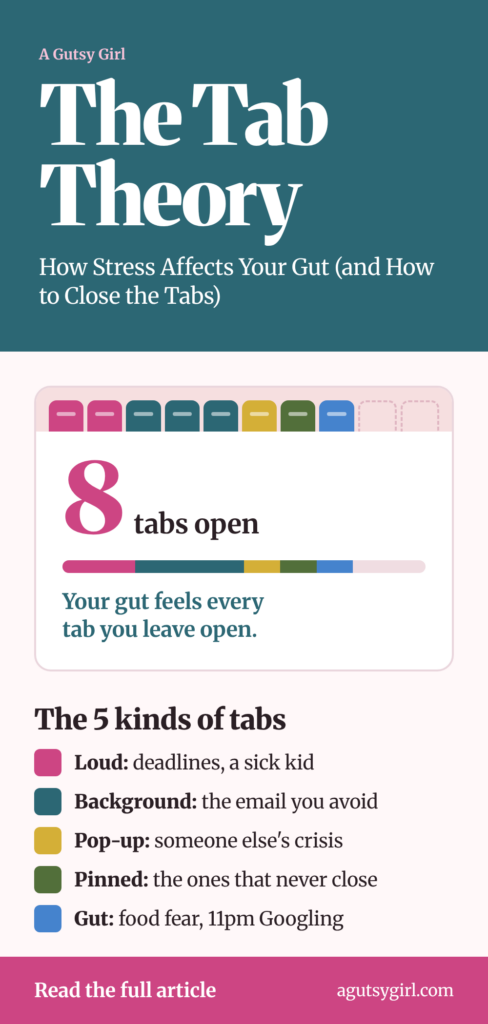
Your mind runs like a laptop with 10 tabs open.
That’s your capacity for the day.
Every stressor opens a tab. The email you haven’t answered. Your kid’s fever. The bloating you’re Googling at 11pm. The argument you keep replaying in the shower.
And here’s the catch: walking away from a tab doesn’t close it.
It keeps running in the background, pulling power.
When all 10 are open, your body starts cutting power to things it can live without for a few hours.
Digestion is near the top of that list. Remember, when we’re running from the bear, digestion is NOT a priority.
Your gut feels every tab you leave open.
The Tab Theory, A Gutsy Girl
Make note: Your symptoms are real. Stress is one more thing acting on a real gut, alongside food, motility, bacteria and everything else you’re already working on.
Credit where it’s due: The Spoon Theory
If you live with a chronic illness, you’ve probably heard of The Spoon Theory.
It was developed in 2003 by writer Christine Miserandino, who created an analogy about having a limited number of daily “spoons” to explain how lupus affected her ability to do everyday tasks.1
She was at a restaurant with a friend when inspiration struck, and she grabbed a handful of spoons to show the daily challenges of long-term illness, when even the smallest task can cost a spoon. In her example, a person wakes up with a set amount of energy, say 12 spoons, and every task spends one.2
Since then, her small student blog has grown into an online community of people who use the theory and call themselves “Spoonies.”3
With gratitude to Christine Miserandino
The Tab Theory is built on The Spoon Theory, written by Christine Miserandino in 2003. Her essay gave millions of people with chronic illness the words for what they live with every day.
The Tab Theory borrows Christine’s best idea: you start every day with a limited amount to spend.
Spoons measure physical energy. Tabs measure mental load, and what that load does to your gut. I’m personally less concerned with the physical limitations, and more concerned with how the stress in our lives is contributing to the lack of healing progress, leading to physical limitations. The gut-brain axis.
Quick tab check
Count what’s open for you right now.
Deadlines, unanswered texts, the decision you keep putting off, the bloating you’re worried about. Each one is a tab.
0 to 4 tabs: you have room.
5 to 7 tabs: running warm.
8 to 10 tabs: your gut is likely feeling it.
Got your number? Tell someone: “I’m at 8 tabs.”
Why your gut pays first
When your brain senses stress, your nervous system shifts into fight-or-flight. Blood and energy go to your heart, lungs and muscles. In an emergency, digesting lunch can wait.
The research backs this up.
One review found that delayed stomach emptying plus faster movement through the colon is the most consistent pattern in how the GI tract responds to acute or short-term stress. (Make note: most of that data comes from animal studies.)4
Your brain and gut are wired together. The brain can affect gut motility, intestinal transit, secretion and gut permeability through the autonomic nervous system.5
For me personally, this is the whole story of my SIBO.
I was first diagnosed in 2014. I relapsed 5 times before I healed for good in 2018. Slow motility was the main driver, and chronic stress was the backbone underneath it.
And for you, open tabs might be a bigger culprit than the food.
It was, hands down, for me.
I just couldn’t see it. Until I could. And then I couldn’t unsee it. And now? After the experience at Rythmia, I’ll NEVER be the same with those tabs.
Make note: Make note: This was my experience, at a medically screened retreat. It isn’t a recommendation, and every tool in this article works without one.
A normal “Tabbies” Tuesday, counted in tabs
| What happened | Tabs open |
|---|---|
| Bad night of sleep (open before you’re out of bed) | 1 |
| 37 unread emails | 1 |
| Skipped breakfast | 1 |
| Work deadline | 2 |
| Unresolved fight with your partner | 2 |
| Wondering what’s causing the bloat | 1 |
| Total by 2pm | 8 of 10 |
You have 2 tabs left for dinner, bedtime and digesting dinner.
The 5 kinds of tabs
Naming the type of tab tells you how to close it.
| Tab | What it is | How it closes |
|---|---|---|
| Loud | Urgent and temporary: a deadline, a sick kid, a move | On its own, once it’s over. Keep it from opening extra tabs while it runs. |
| Background | Unfinished business: the conversation you avoid, the unpaid bill | One decision or one small action. The easiest tabs to close. |
| Pop-up | Opened by someone else: a friend’s crisis, the group text, the news | A boundary, or choosing when you look. |
| Pinned | Never fully closes: caregiving, chronic illness, an old story about who you have to be | It stays open. You can make it smaller. |
| Gut | Opened by your symptoms: food fear, checking your belly, Googling at 11pm | A plan you trust, so you stop re-deciding what’s wrong every time your belly feels off. |
Quick Gut Detox bonus
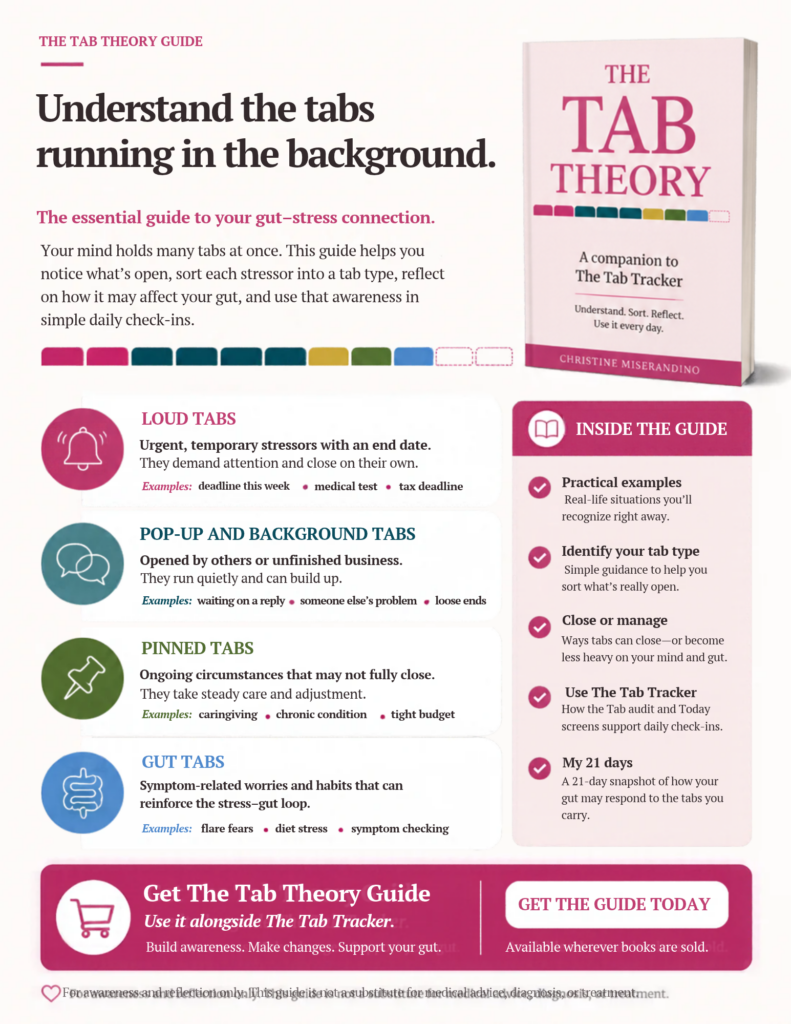
What’s open in your head? The full Tab Theory list
The table above shows a few examples. The full list has 104 tabs across all 5 types, sorted by work, home, money, relationships, health and more, so you can spot the ones you didn’t know you were running.
It comes with The Tab Tracker, free inside the 21-Day Quick Gut Detox. Use code BLOAT to save 25%.
Get the full list in the Quick Gut DetoxThe gut tab loop
This is what keeps so many people stuck, even when they’re doing everything right to heal their gut.
The symptom itself opens a tab.
The gut tab loop
1You feel bloated.
2A gut tab opens: worry, food fear, searching for answers.
3That stress kicks your nervous system into fight-or-flight.
4Your gut slows down and gets more sensitive.
5More bloating. Back to step 1.
The loop breaks at step 2, the gut tab.
The research on this loop is strong. Fear of GI symptoms mediates the relationship between general distress and GI symptom severity, and in one study it was the most robust predictor of IBS quality of life.6
In a study of 811 adults with IBS, gut-symptom anxiety was strongly and independently associated with IBS symptom severity.7
811
adults with IBS in one study. The more they worried about their gut symptoms, the worse those symptoms tended to be.
The 5 rules of The Tab Theory
- Some tabs are heavy. Grief or a sick child can take 4 tabs at once.
- Decisions you put off stay open the longest.
- You can wake up with tabs already open. A flare or a bad night of sleep opens them before your feet hit the floor.
- Tabs carry over. Anything you don’t close tonight is still open tomorrow morning.
- Nobody else can see your tabs. That’s why “I’m fine” sounds so convincing.
How to close tabs
There are 3 levels, from 2 minutes a day to the deep work.
Every day: close 1 tab before bed
- Brain dump everything that’s open onto paper.
- Make one decision you’ve been putting off. Imperfect counts.
- Eat dinner sitting down. Take 3 slow breaths before the first bite.
- Walk 10 minutes after a meal.
Every week: do a tab audit
- List every open tab and label its type.
- Close 2 background tabs with one small action each.
- Set one boundary on a pop-up tab.
The deep work: shrinking a pinned tab
Therapy, somatic work, grief work, a hard conversation, time away.
The Tab Tracker: see your tabs and your gut side by side
The Tab Theory makes sense on paper. But it hits differently when you see it in your own body.
So I built The Tab Tracker, a 21-day tool that comes free inside the 21-Day Quick Gut Detox as a bonus.
It shows you how much your gut is feeling your tabs, using your own numbers.
| Screen | When | What you do |
|---|---|---|
| Tab audit | Day 1 | List everything open in your head and label each tab’s type |
| Today | Every evening | Count your tabs, rate your bloating, log your bowel movement and meals |
| My 21 days | Anytime | See your number, your chart and your heaviest tab type |
| Settings | Once | Set your start date and copy your backup code |
Here’s how to use each part.
Day 1: Your tab audit
Open the Tab audit screen.
List everything that’s open in your head right now, big or small. Give each item a type: loud, background, pop-up, pinned or gut.
The tracker shows how your tabs break down. Then it points you to the one to close first, usually a background tab, because those close fastest.
Every evening: your 60-second check-in
Open the Today screen. It takes about a minute.
- Count your tabs. Tap + next to each of the 5 tab types. A browser window at the top fills with colored tabs as you go, so you can see how close you are to 10.
- Rate your bloating from 0 (none) to 10 (worst).
- Log your bowel movement: none, hard, normal or loose.
- Jot down what you ate and anything that stood out.
It saves as you go. Missed a day? Tap any day number along the top to fill it in.
Close one tab tonight
Every check-in gives you one small, specific way to close a tab, matched to your heaviest tab type that day.
Heavy on gut tabs? It might tell you to skip symptom Googling tonight and write the question down for tomorrow.
When you close one, check “I closed a tab today.”
My 21 days: your number
This is the screen people will screenshot.
Once you’ve logged 3 heavier days and 3 lighter days, My 21 days shows your own comparison. It finds your middle number of tabs, then compares your bloating on the days above it with the days at or below it.
What your number looks like (sample data)
On days with more than 4 tabs, your bloating averaged 6.6. At 4 or fewer, it averaged 2.8.
If the gap is big, your gut is feeling your tabs. If it’s small, food or something else may be the bigger driver, and that’s just as useful to know.
You’ll also see:
- A day-by-day chart of your tabs and your bloating
- A 21-day grid that gets darker pink on heavier days
- Your average tabs, your average bloating and how many days you closed a tab
- Your heaviest tab type across all 21 days
- A Copy my summary button, if you choose to share your number in our Facebook group
Settings
- Start date: set it to your Day 1 of the Quick Gut Detox.
- Backup code: copy it and keep it in your notes app.
- Restore: paste your backup code to bring your entries back.
- Erase everything: wipes your entries from your device.
Your privacy
The Tab Tracker is private to you. Everything you log stays in your own browser, on your own device. It isn’t sent to me or to anyone else.
One catch: use the same phone and browser all 21 days. If you clear your browser data, your entries go with it. That’s what the backup code is for.
The Tab Tracker is a tracking tool to help you notice patterns. It doesn’t diagnose or treat anything. Talk with your doctor about new, severe or worsening symptoms.
Get The Tab Tracker with the Quick Gut Detox
It comes as a bonus inside the 21-Day Quick Gut Detox. Use code BLOAT to save 25%.
Start the Quick Gut DetoxSay it out loud: “I’m at 9 tabs”
Spoonies say, “I’m out of spoons.”
Try this with your partner tonight:
“I’m at 9 tabs.”
It’s 4 words, and they tell the people you love exactly how much room you have left.
The Tab Theory: FAQ
The Tab Theory explains mental load as 10 browser tabs. Every stressor opens one, and unclosed tabs keep running in the background. When too many are open, stress can slow digestion and make your gut more sensitive.
The Spoon Theory, created by Christine Miserandino in 2003, uses spoons to explain the limited physical energy of living with chronic illness. The Tab Theory builds on her idea to explain mental load and how stress shows up in the gut.
Research shows that acute stress can slow stomach emptying and speed up the colon. Studies also link fear of gut symptoms to worse symptom severity in IBS. Stress is one possible driver among many, so talk with your doctor about new or ongoing symptoms.
Yes. Everything you log stays in your own browser on your own device, and nothing is sent anywhere. Use the backup code in Settings to keep a copy.
It’s a free bonus inside the 21-Day Quick Gut Detox.
If you liked this article, you might also enjoy:
- The Somatic-Gut Connection: How Your Nervous System Shapes Digestion (and What Actually Helps)
- Rythmia Before and After: 1 Month Out, My Fears and Full Prep (Review Coming)
- Vagus Nerve Home Remedy [11 Ways for Stimulation]
Xox,
SKH
- https://health.clevelandclinic.org/spoon-theory-chronic-illness ↩︎
- https://www.rcot.co.uk/latest-news/spoon-theory ↩︎
- https://marfan.org/blog/an-ode-to-the-spoon-theory-and-online-communities/ ↩︎
- https://pubmed.ncbi.nlm.nih.gov/11752838/ ↩︎
- https://pmc.ncbi.nlm.nih.gov/articles/PMC6047317/ ↩︎
- https://pmc.ncbi.nlm.nih.gov/articles/PMC5110208/ ↩︎
- https://eprints.whiterose.ac.uk/id/eprint/160777/ ↩︎
Find your next step
One question. A specific plan for where you are right now.
I'm Sarah Kay Hoffman.
20 years with SIBO and IBS. 1,000+ articles written on digestion. A supplement line I formulated myself.
I built The Structured Gut Method™ because I watched thousands of women cycle through the same 4 steps: restrict, feel better, plateau, restart.
Answer one question and I'll tell you where to start.
What do you need right now?