

While I was at Rythmia, I did 2 colon hydrotherapy sessions.
Two.
And I know what some of you are thinking, because I thought it too.
Why would anyone do that on purpose?
So let’s talk about it.
What a colonic actually is, why people get them, what the research says (and doesn’t), the real risks, and exactly what it was like for me.
Colon Hydrotherapy: What It Is, Why People Do It, and What Happened When I Did 2 at Rythmia
Click HERE to save this article for later.
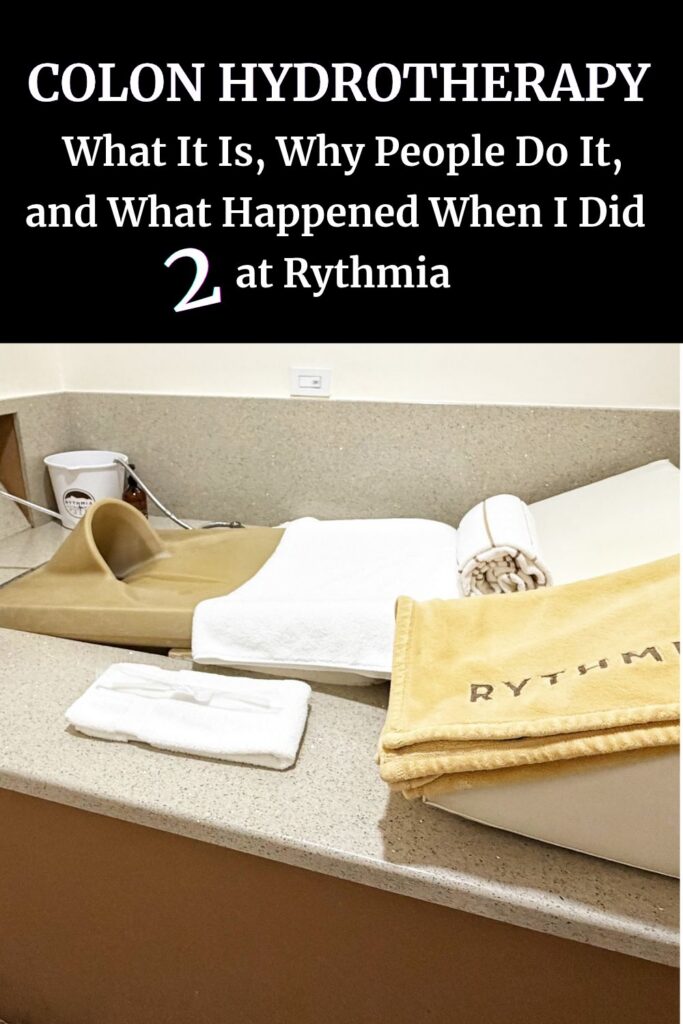
When you go to Rythmia, 2 colon hydrotherapy sessions are included in your stay. Not everyone did 2. In fact, not everyone even did one. But I sure did 2 because, well….curiosity and research.
Colon hydrotherapy at a glance
- What it is: a flush of the large intestine with warm, filtered water, about 30 to 60 minutes.
- Why people do it: constipation, bloating, IBS, “detox,” or as part of a retreat or cleanse.
- What the research shows: possible short-term relief for constipation and IBS. No proof it detoxes the body.
- Biggest risks: dehydration, electrolyte imbalance, infection from poorly cleaned equipment, and a temporary hit to your gut bacteria.
- Does it help SIBO? No. It only reaches the large intestine.
I’m not a doctor. Talk with yours first if you have a bowel condition, kidney or heart disease, or you’re pregnant.
But first, what is colon hydrotherapy?
Colon hydrotherapy (also called a colonic, colonic irrigation, or a hydrocolonic) is a flush of the large intestine with warm, filtered water.
A small tube goes into the rectum. Water flows in, the colon fills, then it releases. That cycle repeats for about 30 to 60 minutes.
It’s different from an enema. An enema uses a small amount of liquid and mostly reaches the lower colon. A colonic tries to rinse the whole colon, which is about 5 to 6 feet long, using roughly 40 to 60 liters of water per session, according to the Monash University FODMAP team1.
There are 2 main setups:
- Closed system: a therapist runs the fill and release, and waste leaves through a sealed tube.
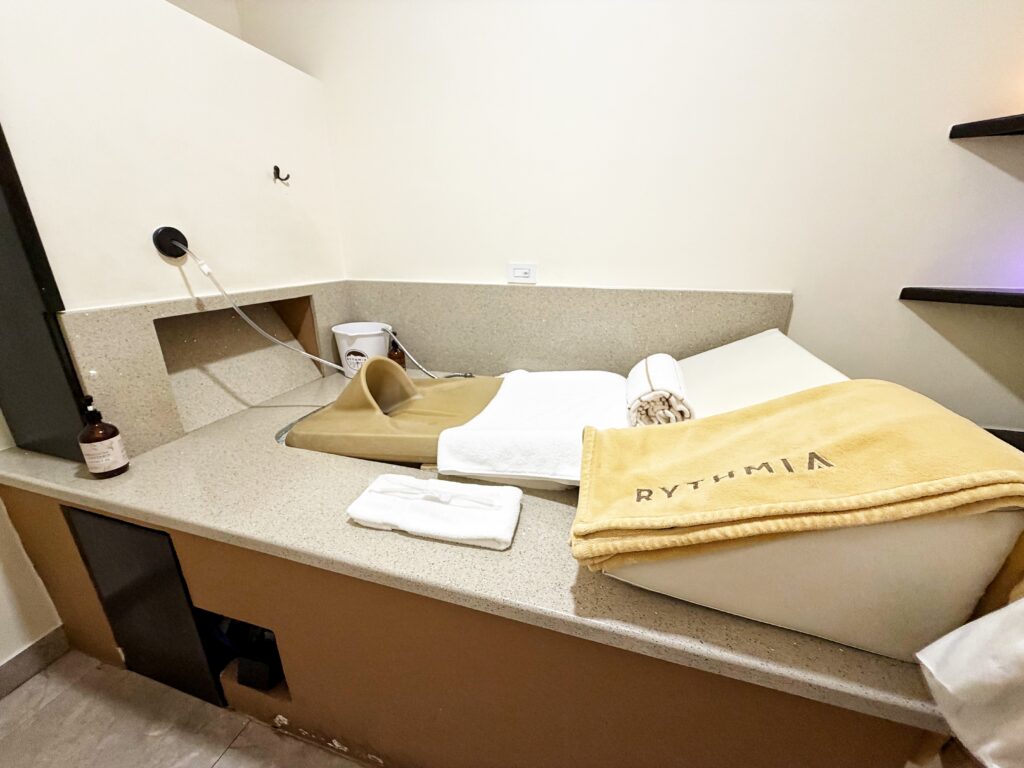
- Open system: you often insert a thin tube yourself and lie over a basin, with more privacy.
While at Rythmia I did 2 x Dead Sea Hydrocolonic Cleanses via an open system. They were done in a small, private room. And everything was set up for comfort: pillows, blankets, a heating pad for my stomach.
Where did this idea even come from?
Rinsing the bowel goes back to ancient Egypt.
But the modern version started in the late 1800s with a theory called autointoxication: the idea that waste sitting in your colon leaks toxins into your blood and slowly poisons you.
John Harvey Kellogg (yes, that Kellogg) ran a sanitarium in Battle Creek, Michigan, and blamed most illness on the bowels. By the 1920s, colon irrigation machines were common in doctors’ offices.
Then mainstream medicine dropped the theory, and colonics moved to spas, wellness centers, and retreats like Rythmia.
Here’s what I find fascinating. A 2018 history paper argues those early researchers were onto something real: gut microbes do affect the whole body, including mood. That’s the gut-brain connection we talk about here all the time, and to which I just released an entire article: The Somatic-Gut Connection: How Your Nervous System Shapes Digestion (and What Actually Helps).
Why do people get colonics?
Most people book one for 1 of 2 reasons.
A medical one: clearing the bowel before a scan or scope.
Or a wellness one: to feel lighter, “detox,” or reset. At a retreat, that’s almost everyone.
| Reason people give | What they’re hoping for | What the evidence says |
|---|---|---|
| Bowel prep | A clean colon before a colonoscopy or X-ray | The only use FDA-cleared devices are cleared for. |
| Constipation | Regular, easier bowel movements | Small studies show short-term relief. No long-term data. |
| Bloating and gas | A flatter, more comfortable belly | Can relieve pressure for a while. Doesn’t reach the small intestine, where SIBO gas starts. |
| IBS symptoms | Less pain, more predictable stools | 1 small pilot study (18 people) showed short-term improvement. |
| “Detox” | Remove built-up toxins and old waste | No evidence. Your liver, kidneys and gut lining already do this. |
| Energy, skin, mood | Feel better overall | Anecdotes only. Not studied. |
| Weight loss | A lower number on the scale | You lose stool and water, the same as after a bowel movement. No fat loss. |
| Part of a retreat or cleanse | A full reset alongside fasting, juice or sauna | Common at retreats. Never studied as a package. |
I obviously chose the second, but I will say that if doing a colonic or two prior to a colonoscopy vs. drinking the prep was an option, I would do a colonic – hands down, no questions asked. I struggle with the prep drink so much, and the colonic felt like a breeze.
What does the research actually say?
In order to make a good decision, you need to know what the science shows.
And for colonics, the honest answer is: not much.
Two major reviews (Acosta & Cash, 2009 and Mishori et al., 2011) found no good-quality evidence of general health benefits. A few small studies show short-term relief for constipation and IBS.
| Study | Who | What they found | Keep in mind |
|---|---|---|---|
| Acosta & Cash, 2009 Systematic review |
16 published articles | No good-quality evidence of health benefits. Many reports of harm. | Only 2 were clinical trials. |
| Mishori et al., 2011 Review, Georgetown |
20 studies from the prior decade | Little evidence of benefit. Side effects from cramping to kidney failure. | Covers home cleanse products and spa colonics together. |
| Hsu et al., 2016 Pilot study, Taiwan |
18 IBS patients who hadn’t responded to medication | Less pain and distress, more satisfaction. Hard stools in IBS-C dropped from 45% to 13%. | Tiny, no control group, 7 days of follow-up. |
| HyGIeaCare study, 2018 Constipation |
175 people with hard-to-treat constipation | Reported as safe and effective. | An author consults for the device maker. No long-term data. |
| University of Vienna trial Microbiome |
68 adults with IBS or food intolerances | 2 to 5 colonics, then 5 weeks of probiotics. Measured gut bacteria and comfort. | Completed, but results were never posted. |
Mayo Clinic, the NIH, and the FDA all land in the same place: no proof colonics detox the body, boost immunity, or help people who don’t have a bowel problem.
But no proof isn’t the same as no effect. Most of what people report after a colonic simply hasn’t been studied.
I’m telling you both, because you deserve both.
What it was like for me
I wasn’t nervous to do the colonic nor did I find it off-putting. Then again, investigating all things gut is my life’s work. It was only a source of curiousity for me.
People have been asking my thoughts on the colonic itself + process for years, but there was no way I could write or talk about until until I personally had an experience.
Before session 1:
I was already eating very clean and minimal, since I had been on the Rythmia Dieta for quite some time. I do think this helped have a better experience. After all, during a colonic everything comes out so you have to take that into consideration.
During Session 1:
If you don’t do a colonic according to instructions, it could feel very uncomfortable.
So I laid there as still as possible. I put a heating pad over my stomach. I could feel the water going in, and at that moment I would release. If you try to hold anything in, you will feel cramping and an unpleasant sensation.
The goal is to let it all out.
The best way I can describe the feeling is having the urge to all the sudden go to the bathroom. If you make it to the bathroom and just go, you feel relief. If not, you’ll feel miserable.
Same with the colonic.
My first session was about 35 minutes long.
After session 1:
My stomach was grumpy for about 10 more minutes. I simply went to the bathroom, and that was it.
And I felt fantastic! At Rythmia, they give you a shot of Chlorophyll. Research has found it has anti-inflammatory effects.2 It was deep blue-ish/green, and I did not like the taste, but in doing research afterwards was glad they provided it.
Because I knew so much had been cleared out, I also went back to my room and took a GOOD GUYS probiotic. And yes, yes I always travel with my probiotic. I was so thankful for it in this moment.
The next session:
I did my 2nd colonic 3 days later. Everything was the same as the first, but this time I only did it for 20 minutes, since I had just received one a few days prior.
Doing the 2 colonics fit with everything else at Rythmia – releasing it all. From the colonic, I felt lighter and better.
And just a day later I was personally forming bowel movements like normal. There were no lingering effects, though I’m not saying that you would always have this same experience.
The real risks
Most side effects are mild and pass within a day: cramping, bloating, nausea, and feeling a little dizzy or drained.
The serious ones are rare but real.
- Dehydration and electrolyte imbalance. Your colon’s job is to absorb water and salts. A big flush can tip that balance, especially if you’re fasting at the same time.
- Infection. Poorly cleaned equipment has caused outbreaks. In one documented case, at least 36 people at a single clinic caught a parasite; 6 died.
- Perforation. A tear in the rectum or bowel from the tube.
- Additives. Coffee and herbal colonics carry extra risk. Mayo Clinic links coffee enemas to many deaths. (Though in the researched article link they don’t provide any information around this.)
Skip it, or talk to your doctor first, if you have: Crohn’s, ulcerative colitis, diverticulitis, recent abdominal surgery, severe hemorrhoids, kidney disease, heart disease, or you’re pregnant.
I don’t share these to scare you, but to continue with full transparency and authenticity on my website. Clearly NONE of these were my personal experience, but I think it’s only right to always share all sides.
What about your gut bacteria?
This is the part I care about most for you.
Flushing the colon washes out bacteria, too. Research on bowel prep found a single flush cut total gut microbes about 31-fold.
The good news? Studies of colonoscopy prep show the microbiome usually bounces back in about 2 to 4 weeks.
What nobody has studied: what repeated colonics do over months or years. While I did 2 during my time at Rythmia, this is NOT a practice I’d do time-and-time again. Moving forward, I can see myself doing one maybe 1 x per year and/or as part of colonoscopy prep.
So if you do one, feed your gut afterward. Fiber, fermented foods, water, and a quality probiotic. I did all of these, and then some.
Will a colonic help SIBO?
No.
I know many of you are here because of SIBO, so I want to be clear on this one.
SIBO is overgrowth in the small intestine. A colonic only reaches the large intestine, which is downstream. You might feel less bloated for a day because your colon is empty. The overgrowth is still there.
If you’re thinking about booking one
Ask these 5 questions first:
- Are you I-ACT certified or state licensed? At what level?
- Is the system closed or open? Are the nozzle and tubing single-use?
- How is the water filtered, and what goes in it? (Plain water is the safer answer.)
- What health conditions would make you turn me away?
- What should I eat and drink before and after?
Expect to pay about $75 to $175 per session in the US. Insurance won’t cover it.
My take
I would do one again in a heartbeat!
For the slow, everyday work of a calmer, more regular gut, the basics still win: fiber, water, movement, sleep, and finding the root cause.
Rythmia: The World’s First Medically Licensed Ayahuasca Retreat
Experience 4 life-changing ceremonies in a luxurious, medically supervised setting.
Learn all about retreating at RythmiaI’m sharing my own experience. I’m not a doctor, and this isn’t medical advice. If you have a bowel condition, talk with your doctor before trying a colonic.
You might also enjoy:
- Why I Made My Own Probiotic GOOD GUYS
- What Is Rythmia? Why I’m Doing Ayahuasca in Costa Rica (November 2026)
- Constipation vs. Slow Motility: How to Tell the Difference [And Why It Matters]
Xox,
SKH
- https://monashfodmap.com/blog/colonic-irrigation/ ↩︎
- https://www.medicalnewstoday.com/articles/chlorophyll-water#benefits ↩︎
Find your next step
One question. A specific plan for where you are right now.
I'm Sarah Kay Hoffman.
20 years with SIBO and IBS. 1,000+ articles written on digestion. A supplement line I formulated myself.
I built The Structured Gut Method™ because I watched thousands of women cycle through the same 4 steps: restrict, feel better, plateau, restart.
Answer one question and I'll tell you where to start.
What do you need right now?


