

I was first diagnosed with SIBO in 2014. I relapsed 5 times before I healed for good in 2018.
Upon returning from Rythmia, I posted THIS Instagram video. This article is the follow up to the video because I wanted to go deep on it.
But/And, almost all the issues that became foundational issues (ie. slow motility, low stomach acid, etc.) for the downward spiral of my gut were always rooted in deep stress. Sometimes it was stress I clearly knew, and other times stress I had no idea was being inflicted.
The idea and topic of stress is nothing new to me. I’ve written about it a ton throughout the years of my journey with A Gutsy Girl.
So when “somatic” and “nervous system regulation” were a core recurring theme during my time at Rythmia, I had 2 reactions. Yes, this is real. And also, I have never given it the attention it deserves.
Here’s what’s proven, what’s promising and what’s overstated. Plus one 5-minute breathing practice you can do tonight.
The Somatic-Gut Connection: How Your Nervous System Shapes Digestion (and What Actually Helps)
Click HERE to save this article for later.
What does “somatic” mean for gut health?
“Somatic” comes from the Greek soma, meaning body. In wellness content, it means working on symptoms through the body: breath, sensation, movement and touch.
You’ll see 3 terms used as if they were the same thing online. They’re different, and the difference matters when you’re deciding what to try.
One more term worth knowing.
IBS and similar conditions now have a new medical name: disorders of gut-brain interaction, or DGBI. They used to be called functional GI disorders1. The gut-brain link is right there in the diagnosis now.
How does your nervous system run digestion?
Your gut and brain talk in both directions, through nerves, hormones and the gut’s own nervous system. Most of that traffic runs from the gut up to the brain.
Here are the 4 parts worth knowing.
Your gut has its own nervous system
The enteric nervous system (ENS) lines your whole digestive tract. It runs motility, secretion and blood flow in the gut.
It has over 100 million neurons. Some estimates go as high as 600 million, which is more than your spinal cord2.
And it can run digestion without any input from your brain. That’s where the “second brain” nickname comes from.
Make note: the ENS controls digestion. It doesn’t think, and it doesn’t hold emotions.
The vagus nerve mostly carries messages up
The vagus nerve is the main link between your gut and your brain on the rest-and-digest side.
Source3
Fight-or-flight slows digestion down
When your brain senses danger, the sympathetic nervous system kicks in. It dials back jobs that can wait, like digesting food and moving it through your gut.
In 2024, Caltech researchers published a study in Nature showing specialized neurons in the abdomen that control different parts of digestion.4
Your brain reads gut signals, sometimes too loudly
Interoception is how your brain detects and interprets what’s happening inside your body.
A 2024 review of 38 studies found that people with functional GI disorders process gut signals differently in the brain (IJMS, 2024). Early data also suggest interoception-based practices can reduce symptoms.
This is where visceral hypersensitivity comes in. Your gut feels normal stretching or gas as pain (Farmer & Aziz, 2013). It’s common in DGBI, though not everyone has it.
If you’ve ever said, “My tests are all normal, but I hurt,” this is one real explanation.
A molecule your body already makes: DMT and the sigma-1 receptor
Here’s a pathway that doesn’t get talked about enough, and it’s a real one.
Your body makes small amounts of DMT on its own. In a 2009 Science paper, researchers found that DMT acts on something called the sigma-1 receptor, a protein inside your cells that helps manage stress, inflammation, and nerve signaling.5
Why does that matter for your gut? Because that same sigma-1 receptor shows up in the digestive tract, and switching it on appears to calm gut inflammation. In a rat study of colitis, a drug that activates the sigma-1 receptor cut colon damage roughly in half and lowered inflammatory markers like IL-6. The researchers floated it as a possible future target for inflammatory bowel conditions.6
One more piece, because the pharmacology is the whole point. DMT barely lasts in your body on its own. An enzyme called MAO (monoamine oxidase) breaks it down almost immediately. This is exactly why ayahuasca combines a DMT-containing plant with a second plant that blocks MAO. Without the MAO block, the DMT never gets a chance to act.
So where does that leave us? With a genuinely interesting mechanism and no finish line yet. The sigma-1 pathway is real. The anti-inflammatory gut signal is real in animals. But nobody has shown that DMT or ayahuasca heals a human gut, and the acute effects of ayahuasca include intense nausea and vomiting. This is a research story to watch, not a protocol to try. If you ever explore anything in this space, it’s a conversation for a qualified professional. It’s also why I chose Rythmia when exploring with ayahuasca; it’s the world’s first medically licenced retreat.
Why does stress hit your gut so hard?
Source7
That one fact explains a lot of symptoms you probably already know:
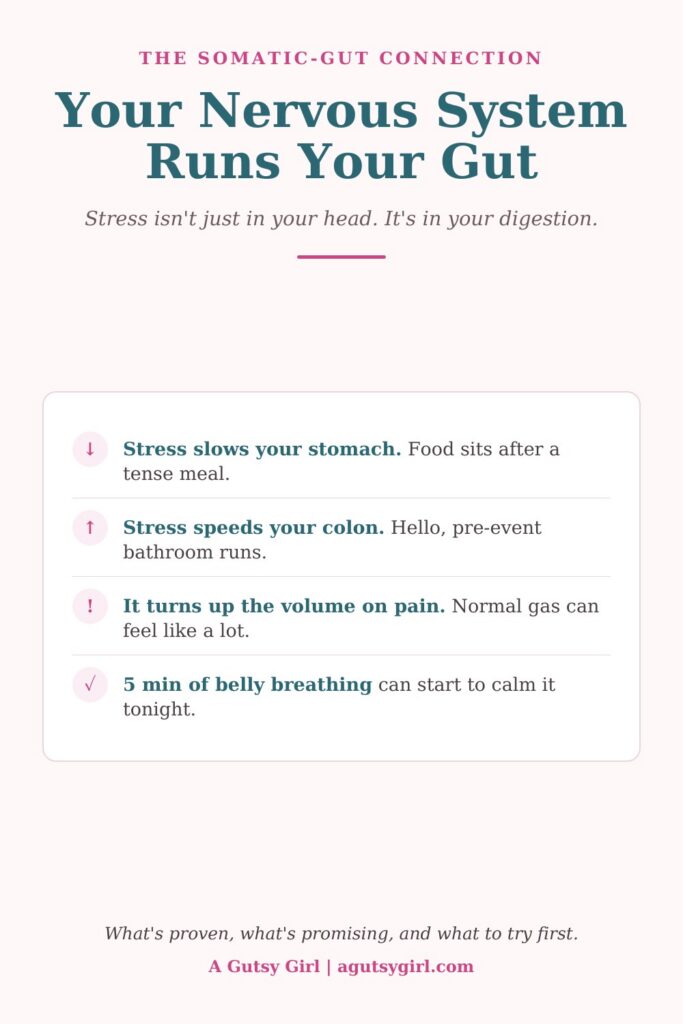
- Racing to the bathroom before a big event. Stress speeds up how fast things move through your colon. The evidence is strong in animals and consistent in humans.
- Food “sitting” in your stomach after a tense meal. Fullness and nausea after stressful eating come from delayed stomach emptying. It’s the most common gut response to acute stress.
- Pain that feels out of proportion. That’s visceral hypersensitivity again. Mast cells in the gut lining appear to be involved8.
- Flares during anxious stretches. The colon’s stress response seems to be exaggerated in IBS, though human data are still limited.
IBS affects an estimated 4.4% to 4.8% of people, and it’s more common in women.
Now, a caveat. In one randomized trial, a drug that blocks the main CRF stress receptor didn’t change bowel speed or stool habits in women with IBS-D9. So stress is one driver. Motility, immune function, your microbiome and diet all play in too.
To fix a problem, you need to understand the cause of that problem. For me, slow motility was the culprit behind recurring SIBO. But chronic stress was the backbone.
If constipation is your main symptom, read Constipation vs slow motility: how to tell the difference.
Childhood stress, trauma and IBS: what the research shows
People with IBS report more adverse childhood experiences (ACEs) than people without it. The largest study to date found a 38% to 64% higher risk of developing IBS later in life.
That’s an association. Here’s what the 3 biggest studies found.
- The UK Biobank study followed 126,735 adults for a median of 14.5 years. 2,492 developed IBS. High childhood emotional neglect was linked to 38% higher risk, and high childhood abuse to 64% higher risk, compared with people who had few ACEs.10
- A 2016 UCLA study compared 148 IBS patients with 154 people without IBS. 75.7% of the IBS group had at least 1 ACE, versus 59.7% of the others. The link got weaker once anxiety and depression were factored in.11
- A 2022 meta-analysis pooled 15 studies and 272,686 people. Overall, the link was uncertain because the studies varied so much. In women, ACEs were tied to IBS. In men, there was no significant link.12
Most people with gut symptoms have no trauma history. And many people with ACEs have perfectly healthy guts. If this section doesn’t describe you, nothing is missing from your story.
If it does describe you, here’s the useful part. Early stress can keep your stress response on high alert for years, and that can affect digestion. The brain-gut therapies in the next section can help either way.
If you’d like support, look for a licensed therapist who works with gut conditions. The Rome Foundation GI Psychology directory lists GI psychologists. You might also find my anxiety self-care checklist helpful on the harder days.
Body-based practices that help, ranked by evidence
Gut-directed hypnotherapy and IBS-specific CBT have the strongest evidence, and a gastroenterology guideline behind them. Breathing work has small but encouraging trials. Yoga is mixed. Somatic Experiencing has no gut-specific trials yet.
Sources 13 14 15 16 17 18 19 20 21
Note: I think this is precisely why I’m so interested in Somatic experiencing. Just because there is not a lot of research yet does not mean it doesn’t work. It simply means there is no research. I’d love to see this research evolve 10-fold.
How to do slow belly breathing
This combines the hand placement from the diaphragmatic breathing trial with the timing from the slow-breathing study.
I wrote about this way back in 2012 in Breathe deep. For another body-based practice, read When the feet hold the nervous system.
Supporting digestion while you work on your nervous system
Breathing and brain-gut therapy take weeks. Though, I will personally confirm that the work I did at Rythmia resulted in immediate changes. They say one session of ayahuasca is like 10 years of therapy; I 100% can confirm this as valid.
But still, your gut still has to move in the meantime.
Slow motility was my main driver for recurring SIBO, so keeping things moving matters to me. Even though I did ayahuasca, and believe in all things for reducing stress from a lifestyle standpoint, I still take specific supplements.
Namely, Move Now. As a side note: one day while at Rythmia, I needed more hydration. I went to the clinic, got it, and they gave me magnesium glycinate (which is what Move Now is) + electrolytes (which is why I was so thankful I brought along my LMNT).
Want the full story on magnesium and your gut? Read Magnesium, constipation and digestion.
And if your issue is more that food “sits” after a tense meal, look at Break Down. It’s a blend of digestive enzymes and betaine HCl that supports healthy digestion of protein, fats and carbohydrates.*
*These statements have not been evaluated by the Food and Drug Administration. These products are not intended to diagnose, treat, cure or prevent any disease.
Frequently Asked Questions
What is the somatic-gut connection?
The somatic-gut connection is the two-way link between your nervous system and your digestion. Your gut has its own nervous system, and it talks to your brain mainly through the vagus nerve. Stress changes how fast your gut moves and how sensitive it feels, which is why body-based practices can ease gut symptoms.
Can stress cause constipation or diarrhea?
Stress can contribute to both. Acute stress slows stomach emptying and speeds up the colon, which can mean urgent bowel movements before a big event. Stress is one driver among several, along with motility, immune function, your microbiome, and diet. Ongoing constipation or diarrhea is worth bringing to your doctor.
Does the vagus nerve control digestion?
The vagus nerve is the main rest-and-digest link between your gut and brain, but about 80% of its fibers carry signals from the gut up to the brain. Day-to-day digestion is largely run by the enteric nervous system in your gut wall, which can work without input from the brain.
Can somatic therapy help IBS?
Body-based practices can support digestion, and slow breathing has small, encouraging trials. Somatic Experiencing, the trauma therapy, has no trials on gut outcomes yet. The brain-gut therapies with the strongest research for IBS are gut-directed hypnotherapy and IBS-specific CBT, both suggested in gastroenterology guidance.
What is the fastest way to calm my gut when I’m stressed?
Try slow belly breathing. Put one hand on your chest and one on your belly, breathe so only the belly hand moves, and slow to about 6 breaths a minute for 5 minutes. In small trials, a daily practice like this eased reflux, belching, and indigestion symptoms within weeks.
A note before you go
Your gut and your nervous system are in constant conversation. Learn the pathways, calm the alarm, support the gut while you do.
If you liked this article, you might also enjoy:
- Endocannabinoid System and Your Gut
- What Is Rythmia? Why I’m Doing Ayahuasca in Costa Rica (November 2026)
- Go to Rythmia!
Xox,
SKH
- https://pubmed.ncbi.nlm.nih.gov/33315591/ ↩︎
- https://pubmed.ncbi.nlm.nih.gov/32424503/ ↩︎
- https://pubmed.ncbi.nlm.nih.gov/29467611/ ↩︎
- https://www.nature.com/articles/s41586-024-07802-5 ↩︎
- https://pubmed.ncbi.nlm.nih.gov/19213917/ ↩︎
- https://www.ncbi.nlm.nih.gov/pmc/articles/PMC7312485/ ↩︎
- https://pubmed.ncbi.nlm.nih.gov/12047502/ ↩︎
- https://pubmed.ncbi.nlm.nih.gov/23757398/ ↩︎
- https://pmc.ncbi.nlm.nih.gov/articles/PMC2697942/ ↩︎
- https://www.nature.com/articles/s41398-026-03833-w ↩︎
- https://pubmed.ncbi.nlm.nih.gov/27061107/ ↩︎
- https://journals.sagepub.com/doi/10.1136/jim-2021-002109 ↩︎
- https://pubmed.ncbi.nlm.nih.gov/33315591/ ↩︎
- https://www.sciencedirect.com/science/article/abs/pii/S2468125325002389 ↩︎
- https://pubmed.ncbi.nlm.nih.gov/29104130/ ↩︎
- https://www.tandfonline.com/doi/full/10.1080/00365520701259208 ↩︎
- https://pmc.ncbi.nlm.nih.gov/articles/PMC9673479/ ↩︎
- https://pubmed.ncbi.nlm.nih.gov/40358469/ ↩︎
- https://pubmed.ncbi.nlm.nih.gov/28585761/ ↩︎
- https://www.ncbi.nlm.nih.gov/pmc/articles/PMC5489867/ ↩︎
- https://www.sciencedirect.com/science/article/pii/S0965229925001190 ↩︎
Find your next step
One question. A specific plan for where you are right now.
I'm Sarah Kay Hoffman.
20 years with SIBO and IBS. 1,000+ articles written on digestion. A supplement line I formulated myself.
I built The Structured Gut Method™ because I watched thousands of women cycle through the same 4 steps: restrict, feel better, plateau, restart.
Answer one question and I'll tell you where to start.
What do you need right now?


