

What do you do when SIBO keeps relapsing?
You finished the antibiotics.
You felt amazing. Flat stomach, real energy, food that didn’t fight back.
And then, a few weeks or months later, the bloating crept back in.
If SIBO keeps relapsing for you, I’ve been exactly where you are. More times than I’d like to count.
I have now had zero SIBO relapses since July 2018.
Here’s what the research says about why SIBO comes back, and what actually changed for me.
How common is SIBO relapse?
Very.
In one study, 80 people with SIBO were treated with rifaximin and cleared it on a breath test. Then researchers retested them over time.
12.6% positive again at 3 months | 27.5% positive again at 6 months | 43.7% positive again at 9 months |
That’s close to half in under a year.1
The same study found 3 things linked to coming back: older age, a history of appendix removal, and long-term use of acid-reducing PPI medications.
So if you’ve relapsed, please hear this: you are not broken, and you didn’t fail.
My doctor at the time, Dr. Schweig, told me something I’ve never forgotten:
You have relapsed so many times that I know it’s nothing you are or are not doing. It’s not your fault.
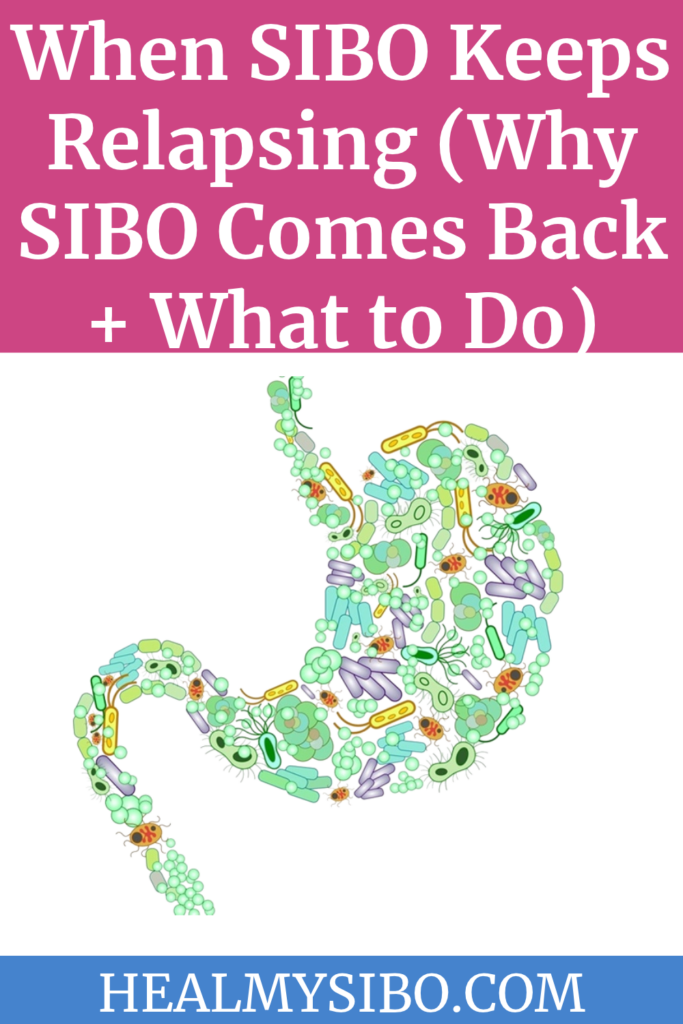
When SIBO Keeps Relapsing (Why SIBO Comes Back + What to Do)
Click HERE to save this article for later.
Why does SIBO relapse?
In order to fix a problem, you need to understand the cause of that problem.
Antibiotics (and herbals) clear the overgrowth. They don’t change why the bacteria were able to overgrow in the first place.
Cleveland Clinic puts it plainly: SIBO is often a complication of another condition, and treatment needs to address the overgrowth, its complications, and the underlying cause.2
Skip the underlying cause, and you’re on a timer.
The trigger vs. the underlying cause
The trigger decides when you relapse.
The underlying cause decides whether you will.
Xox, SKH
This is the single biggest lesson my relapses taught me.
There is always an underlying cause and a trigger. They are 2 different things.
My March 2018 relapse? The trigger was stress, 100%. I had been through a brutal few months and did a poor job managing it.
And my underlying cause? Slow motility plus barely any stomach acid.
Stress was the spark. Slow motility and low acid were why the spark kept catching, over and over.
The most common underlying causes of SIBO
| Underlying cause | Why SIBO can come back | Ask your doctor |
|---|---|---|
| Slow motility | Bacteria aren’t swept out of the small intestine between meals, so they build back up. | “Could slow motility be part of this, and how do we support it after treatment?” |
| Low stomach acid | Less acid means fewer bacteria are killed before they reach the small intestine. Long-term PPI use raises SIBO risk. | “Do I still need my PPI, and is there a plan to review it?” |
| Structural changes | Surgery, adhesions, or other changes can create spots where bacteria collect. | “Could past surgery or adhesions be playing a role?” |
| Other conditions or medications | SIBO often travels with another condition, and some medications raise risk. | “What else should we test for or rule out?” |
Sources: Cleveland Clinic, PMC review
Cleveland Clinic groups the causes of SIBO into chemical and mechanical problems. These are the ones to ask your doctor about.
1. Slow motility
Your small intestine is supposed to sweep itself clean between meals. When that sweeping slows down, bacteria hang around and multiply.
For me personally, slow motility was my main issue with recurring SIBO. And for you, it could be a huge culprit too.
2. Low stomach acid (including long-term PPIs)
Stomach acid kills a lot of bacteria before they ever reach the small intestine.
Less acid, less protection.
A review of 19 studies found PPI use raises the odds of SIBO by about 70%, and SIBO became more common after 1 year of continuous use.3
Make note: Never stop a prescribed PPI on your own. Bring this up with the doctor who prescribed it.
3. Structural changes from surgery or disease
Adhesions, abdominal surgery, and changes to the small intestine can create spots where bacteria collect.4
Remember the appendix finding above? That’s this category.
4. Other health conditions and medications
SIBO often travels with another condition, and certain medications raise risk.5
In my case, Dr. Schweig suspected mold exposure or Lyme disease and wanted to run a full panel of blood work.
I never ended up testing for those because I healed for good in 2018. They’re still worth keeping in mind if you’ve ruled out everything else.
Go deeper on all of these in What Caused Your SIBO.
What to do when SIBO keeps relapsing
1. Confirm it with a test
Bloating can come from a lot of things. Before another round of treatment, retest so you’re treating what’s actually there.
Not sure which SIBO test to get?
Read the SIBO Test Buyer’s Guide2. Name your trigger
Find your trigger
Look back 4 to 8 weeks before your symptoms came back. What changed?
☐ A stressful stretch at work or home
☐ A stomach bug or food poisoning
☐ A new medication
☐ More or harder workouts
☐ Travel
☐ A big change in what or when you eat
Mine was stress caused by things on this list + other. 100%.
3. Push for the underlying cause
Go back to the list above. Ask your doctor which of those have actually been ruled out.
If the answer is “none,” that’s your next appointment.
4. Re-evaluate the protocol
Rifaximin clears SIBO in about 71% of people, based on a review of 26 studies.6 That’s good. It also means some people need a different plan.
Options to discuss with your doctor:
- A different antibiotic combination. My final round was rifaximin for 4 weeks plus neomycin for the first 2. Read the full day-by-day in My 28-Day Rifaximin and Neomycin SIBO Journal.
- Herbal antimicrobials. I compare them side by side in Herbal Antibiotics for SIBO vs. Rifaximin.
- An elemental diet. In one study, 80% of people had a normal breath test after 14 days on an elemental diet.7 Here’s how to do a DIY Elemental Diet for SIBO.
5. Protect the weeks after treatment
This is the window where most relapses start.
What I focused on after my final round:
- Reducing stress (the trigger that got me in 2018)
- Pulling back on workout time and intensity
- Spacing out meals so my gut had time to clear between them. More on that in Fasting to Cure SIBO.
- Asking my doctor about motility support
- Included these 6 supplements after SIBO antibiotics.
And then, of course, how I healed SIBO long term.
A quick word on weight
A doctor once told me, without looking at a single test, “You don’t have SIBO. If you did, you’d be losing a ton of weight.”
Wrong.
Some people with SIBO lose weight. Many maintain or gain. I usually stayed the same or gained slightly, even while eating far more than normal.
Read more in How to Lose Weight with SIBO.
How I finally stopped relapsing
I relapsed in 2016. I relapsed again in March 2018, after almost 2 full years of freedom.
That second one broke my heart a little.
But I kept looking for the underlying cause, finished my final round in July 2018, and changed what I did in the weeks after.
I haven’t relapsed since.
The whole story is in How I Healed SIBO Long Term.
Zero relapses since July 2018
Everything I learned, step by step
Reasonable SIBO is the guide I wish I’d had during my relapses: testing, treatment options, food, and what to do in the weeks after treatment.
Get Reasonable SIBOSIBO relapse FAQ
How often does SIBO come back after treatment?
In one study of people treated with rifaximin, 43.7% tested positive again within 9 months.8
Why does SIBO keep coming back?
Treatment clears the overgrowth. If the underlying cause (such as slow motility, low stomach acid, structural changes, or another condition) is still there, bacteria can overgrow again.
Can stress cause a SIBO relapse?
Stress was the trigger for my 2018 relapse. A trigger usually sets off a relapse on top of an underlying cause that hasn’t been fixed yet.
Is it possible to stop SIBO from relapsing?
For many people, yes. I’ve had zero relapses since July 2018. Finding and addressing the underlying cause, with a doctor, is what made the difference for me.
Let’s do this together:
PRIVATE 1-on-1 Gut Health Coaching
Here’s what I’ve learned in over fifteen years of doing this work: nobody fails at gut healing because they didn’t have the plan. They fail because they’re doing it alone.
Learn More + Apply for a SpotIf you liked this post, you might also enjoy:
- The 3 Types of SIBO: Hydrogen, Methane (IMO), and Hydrogen Sulfide Explained
- How to Heal SIBO: 5 Steps to Start (From Someone Who Did)
- GLP-1 Medications and SIBO: Can Ozempic, Wegovy, Mounjaro, or Zepbound Trigger Bacterial Overgrowth?
Xox,
SKH
- https://pubmed.ncbi.nlm.nih.gov/18802998/ ↩︎
- https://my.clevelandclinic.org/health/diseases/21820-small-intestinal-bacterial-overgrowth-sibo ↩︎
- https://pmc.ncbi.nlm.nih.gov/articles/PMC10303511/ ↩︎
- https://my.clevelandclinic.org/health/diseases/21820-small-intestinal-bacterial-overgrowth-sibo ↩︎
- https://my.clevelandclinic.org/health/diseases/21820-small-intestinal-bacterial-overgrowth-sibo ↩︎
- https://pmc.ncbi.nlm.nih.gov/articles/PMC5299503/ ↩︎
- https://pubmed.ncbi.nlm.nih.gov/14992438/ ↩︎
- https://pubmed.ncbi.nlm.nih.gov/18802998/ ↩︎
Find your next step
One question. A specific plan for where you are right now.
I'm Sarah Kay Hoffman.
20 years with SIBO and IBS. 1,000+ articles written on digestion. A supplement line I formulated myself.
I built The Structured Gut Method™ because I watched thousands of women cycle through the same 4 steps: restrict, feel better, plateau, restart.
Answer one question and I'll tell you where to start.
What do you need right now?






I’m hoping that you find this response helpful, but I’m currently fighting SIBO. Findings are that most people who hit SIBO with antibiotics will relapse. I won’t touch antibiotics with a 10 foot pole, and instead am rebalancing my gut using the Gut Thrive program from Christa Orrechio. http://www.thewholejourney.com
My functional medicine doctor also gave me a round of herbal remedies (FC Cidal & Disbiocyde- check my spelling) which you can find additional info about on http://www.siboinfo.com
It’s a long process to first starve the overgrowth, then eliminate pathogens, then re-seed your gut so that the biome is balance. This is done with diet & supplements over a period of about 12 weeks. The minute you do antibiotics, you may be killing the bad bacteria, but you are also everything in your gut that you need for a healthy biome and possibly allowing candida to overgrow, or parasites to take over, etc. This is why the bacteria overgrowth relapses because you don’t have the biome in your gut to stop overgrowth from happening again.
If you keep relapsing, I recommend avoiding antibiotics. It’s a slower process, but the success rate is much higher, and then of course there is the maintenance diet.
I hope this helps!
Anyone who doubts the reality of SIBO is uneducated or irrational. The gut biota is very real and fragile. Most MD’s and so-called specialists are utterly clueless IMO and can actually do damage. It is definitely possible to heal from SIBO and not relapse. I predict sometime in the future that there will be medical specialists who deal specifically with optimizing and healing the gut microbiota.
I’m a survivor of a particularly bad case of SIBO. My biota became very toxic, and my body’s health and my weight massively declined between 2013-2015. I took several breath tests to confirm this. I was in constant pain from the inflammation, very constipated, with lots of upper intestinal gas after eating for most of 2015. In 2015 my gut lining started to degrade and I developed a bad case of leaky gut, and I was reacting to proteins (like milk and corn) I could formerly handle. I was literally on death’s door. My weight went from 155 to 116 pounds. No diet or protocol worked, I tried them all (like low/no FODMAP, SCD, etc.).
The only thing that saved me were several large doses of Rifaximin+herbal antibiotics (Allimax, oregano oil, etc.), combined with anti-biofilm agents, followed by large amounts of pharmaceutical probiotics, probiotic yogurt, and prebiotics (Inulin and arabinogalactan). I had to closely follow a no FODMAP diet for ~6 months, then I slowly introduced various fibers starting with fermented Sauerkraut. Even after the antibiotics I was still in a large amount of inflammation but as my gut healed I returned to normal.
It took several rounds of antibiotics because the gut microbiota is surprisingly strong. Whatever bacteria that grew into my small intestine and lower stomach was extremely resilient. I think I took 3 or 4 courses over a period of a year, with the 4th course lasting around 6 weeks. After the pharma antibiotics I switched to around 2-3 months of herbal antibiotics along with 4 tablespoons of “Date Lady” date syrup/day which is surprisingly antibacterial and antifungal. (I actually ordered a box of the stuff.) I was still in pain from the gut inflammation, but at this point when probiotics started working as a pain/inflammation reliever I knew I had to stop anything antibacterial and start the pro/prebiotics.
I followed the treatment protocol here, but I combined the pharma and herbal protocols and it took several tries: https://www.siboinfo.com/
It was a dangerous protocol, but I had no choice as I was dying. I wouldn’t recommend anyone do this without having no other options. I suspect most cases of SIBO aren’t nearly as bad as mine was, and it wouldn’t take nearly as much antibiotics to help correct.
After this was over, I felt like a poison left my body. It was the hardest thing I’ve ever done, and I haven’t regressed. I am now more or less dependent on daily probiotic yogurt and I must eat lots of vegetables along with prebiotics to keep my gut healthy. If I don’t do this I’ll feel some background inflammation and my motility slows down.
My nutritional status declined during all this from malabsorption. I developed a severe omega 3 deficiency (which one of my doctor’s caught indirectly) and B vitamin (especially folate) deficiencies which I’m still correcting.
Most of the immune system is in the gut. If your biota gets unbalanced the immune system has to take over to prevent your biota from literally eating you alive. When the immune system gets upregulated from a weak or unbalanced biota all sorts of downstream effects all over your body can occur. If you gut is messed up and you develop acne and bad allergies out of the blue it could mean that your immune system has become upregulated due to an unbalanced gut biota.
I would recommend to anyone with SIBO or IBS to find an experienced doctor or naturopath for help – they do exist. Treating SIBO involves purposely and forcefully “reshaping” your gut biota, which isn’t easy and takes time and patience. You must keep your motility up and become closely attuned to your body (especially inflammation). I tracked my gut biota over time using ubiome.com.
Just found your blog after doing some research . I was just diagnosed with Sibo and was looking into the elemental diet. Just curious why you would never do it? Thanks!