

Did you know there are three different types of SIBO?
Most people hear the word SIBO and picture one thing: bloating, a distended belly, that pregnant-looking stomach by 3pm. But SIBO is not one single condition with one single treatment.
It comes in three distinct patterns, each driven by a different kind of microbe, each producing a different gas, and each showing up with its own set of symptoms. Hydrogen. Methane. Hydrogen sulfide.
And here is the part that matters for anyone who has treated their SIBO and watched it come right back: if you don’t know which type you have, you can do everything “right” and still not get better.
For me personally, my recurring SIBO came down to slow motility and the wrong approach for far too long. I relapsed more times than I want to admit before I understood that the type you have changes the entire plan.
Furthermore, I’m not just writing this article from a medically-researched standpoint. At one point or another I was diagnosed with all types of SIBO. I relapsed 5 times, from 2014 – 2018, and have been healed since 2018.
So let’s break down all three.
Click HERE to save this information for later.
But first, what is SIBO?
SIBO stands for small intestinal bacterial overgrowth. It happens when bacteria that normally belong in your large intestine show up in excess numbers in your small intestine, where they were never supposed to set up camp.
Your small intestine is meant to be relatively low in bacteria. It is where you digest and absorb most of your food. When too many microbes move in, they start fermenting your food before your body can properly use it. That fermentation produces gas. The gas produces the bloating, pain, and bathroom chaos.
SIBO is incredibly common and wildly underdiagnosed. Research suggests that up to 80% of people with IBS may actually have SIBO as an underlying cause, according to work published in the World Journal of Gastroenterology.1
Read that again. Up to 80%. Which means a huge number of women walking around with an “IBS” label have never been tested for the thing that may be driving it.
In order to fix a problem, you need to understand the cause of that problem. With SIBO, the first step is understanding which gas, and which microbe, you are actually dealing with.
Why the gas matters
Here is the simple version of the science.
Different microbes eat the carbohydrates in your gut and release different byproducts. Those byproducts are gases. We can measure those gases on your breath, because they get absorbed into your bloodstream and exhaled.
That is the whole basis of SIBO breath testing: feed the microbes a sugar, then measure what they produce.
The three gases:
- Hydrogen points to classic bacterial overgrowth.
- Methane points to an overgrowth of methane-producing archaea, now called IMO.
- Hydrogen sulfide points to an overgrowth of sulfide-producing bacteria, sometimes called ISO.
Same umbrella condition. Three very different drivers. Let’s take them one at a time.
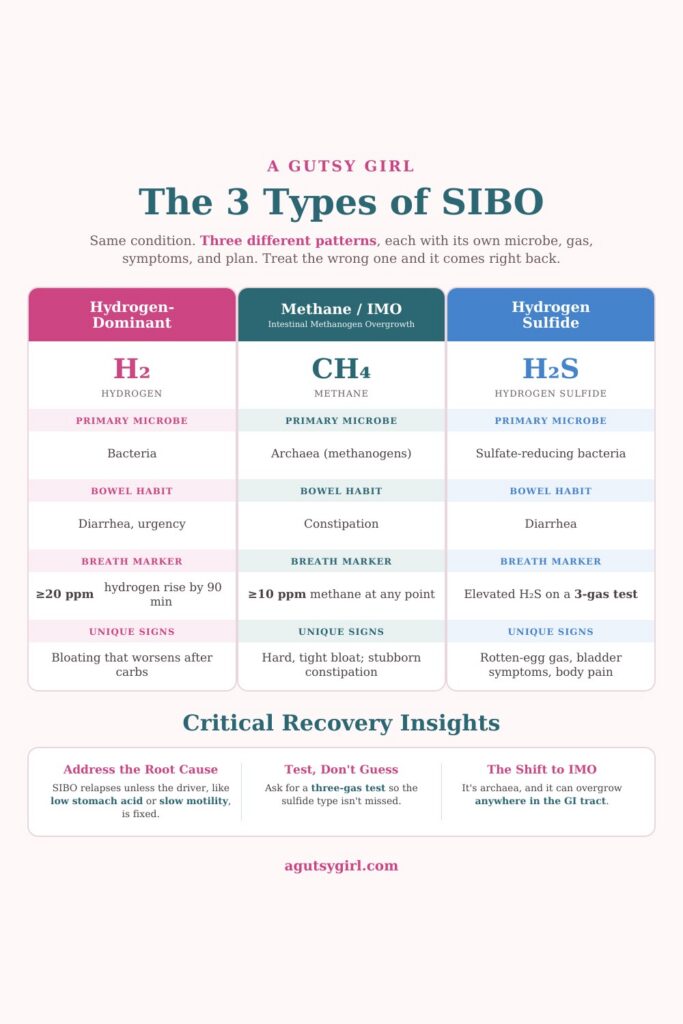
Type 1: Hydrogen-dominant SIBO
This is the one most people think of when they hear “SIBO.” It is the original, the classic, the one the condition was basically named around.
What causes it:
An overgrowth of hydrogen-producing bacteria in the small intestine. These bacteria ferment the carbohydrates you eat and release hydrogen gas as a byproduct.
The primary microbes:
Bacteria, not archaea. Common players include species of Escherichia coli, Klebsiella, and various Proteobacteria and Firmicutes.2
The signature symptom:
Diarrhea or looser, more frequent stools. Hydrogen tends to speed things up.
What it feels like:
Bloating that often worsens through the day and after meals, especially after carbs, sugar, and high-FODMAP foods. Gas, abdominal pain, and that uncomfortable fullness. Many people also notice diarrhea or urgency.
On a breath test:
A rise in hydrogen of at least 20 ppm above your baseline within 90 minutes is considered positive for SIBO, per the North American Consensus on breath testing.3
I already wrote a full deep-dive on this one. If hydrogen-dominant SIBO is your focus, read the complete breakdown here: What Is Hydrogen-Dominant SIBO?
Type 2: Methane-dominant SIBO, now called IMO
This is the type that confuses people, partly because the name officially changed.
Methane-dominant SIBO is now more accurately called IMO: intestinal methanogen overgrowth. The rename happened for two real reasons.4
First, the organisms responsible are not technically bacteria at all. They are archaea, a completely separate branch of life. So calling it “bacterial overgrowth” was never quite right.
Second, these methane producers are not confined to the small intestine. They can overgrow anywhere along your digestive tract, including the large intestine. “Small intestinal” no longer fit.
What causes it:
An overgrowth of methane-producing archaea, most commonly Methanobrevibacter smithii. These organisms consume hydrogen and produce methane gas.5
The primary microbe:
Archaea (methanogens), not bacteria.
The signature symptom:
Constipation. This is the big one. Methane gas has been shown to physically slow down intestinal transit, which is why IMO is so strongly linked to constipation and to IBS-C.6
What it feels like:
Constipation that can be stubborn and chronic. Bloating, often described as hard or tight. Many people with methane overgrowth also report feeling like food just sits there. Some notice weight changes they can’t explain, because methane’s effect on motility and calorie absorption is an area of active research.
On a breath test:
A methane level of 10 ppm or higher at any point during the test is considered positive for IMO, per the North American Consensus.7
This was a huge piece of my own puzzle. My main issue with recurring SIBO was slow motility, and methane and motility are deeply tangled together. If your transit is slow, microbes have more time to overgrow, which can produce more methane, which slows transit even further. It becomes a loop.
I wrote a full post on this type too. Read it here: What Is Methane-Dominant SIBO?
Type 3: Hydrogen sulfide SIBO
This is the newest of the three to be measurable, and it is the one most commonly missed. For years, standard breath tests only measured hydrogen and methane. Hydrogen sulfide was invisible.
What causes it:
An overgrowth of sulfate-reducing bacteria that consume hydrogen and produce hydrogen sulfide gas. The usual suspects are Desulfovibrio, Bilophila wadsworthensis, and certain Fusobacterium strains.8
The primary microbes:
Sulfate-reducing bacteria.
The signature symptom:
Diarrhea, often paired with gas that smells like rotten eggs. That sulfur, rotten-egg odor is the classic tell.9
Read more: Do you smell like rotten eggs?
What it feels like:
Beyond the sulfur-smelling gas and diarrhea, people report a cluster of symptoms that can seem unrelated to the gut: bladder irritation and urgency that can mimic interstitial cystitis, body pain, tingling or nerve-type sensations, brain fog, and fatigue. Many notice they feel worse after eating sulfur-rich foods like garlic, onions, eggs, and cruciferous vegetables, or after taking sulfur-based supplements.10
On a breath test:
For years this type hid in plain sight. On an older two-gas test, a “flatline” of both hydrogen and methane in a person who clearly has gut symptoms can actually be a clue, because sulfate-reducing bacteria consume the hydrogen other microbes make. Newer three-gas breath tests now measure hydrogen sulfide directly, which finally makes this type visible.
A note on numbers: the exact diagnostic cutoff for hydrogen sulfide is still being established and isn’t as settled as the hydrogen and methane thresholds. So if you test, work with a provider who understands three-gas interpretation rather than fixating on a single number.
Sources for this table: North American Consensus (link), Rupa Health IMO overview (link), trio-smart (link).
Can you have more than one type?
Yes. And this is where it gets real.
You can absolutely have hydrogen and methane together. You can have hydrogen and hydrogen sulfide together. The gases interact, because some microbes eat the hydrogen that others produce and turn it into methane or hydrogen sulfide.
This is exactly why a single-number, pass-or-fail approach to SIBO testing falls short, and why so many people “treat their SIBO” and still feel awful. If you only knocked down one gas and left another untouched, your symptoms don’t fully resolve.
How SIBO is tested
The standard tool is a breath test. You drink a measured sugar solution, usually lactulose or glucose, then breathe into collection tubes at timed intervals. The lab measures the gases.
Per the North American Consensus, test prep matters more than people realize:11
- Avoid antibiotics for 4 weeks before testing.
- Stop promotility drugs and laxatives about 1 week before, if your provider agrees.
- Eat a restricted, low-fermentation diet the day before.
- Fast for 8 to 12 hours before the test.
- No smoking and limited physical activity during the test.
If you want to capture all three gases, specifically ask about a three-gas breath test that includes hydrogen sulfide. A standard two-gas test can miss the sulfide type entirely.
Test, don’t guess. I cannot say this enough.
Why SIBO comes back (and the part nobody wants to hear)
Here is the truth that took me years and multiple relapses to accept.
Killing the overgrowth is not the same as fixing the reason it overgrew.
SIBO is almost always downstream of something else. Low stomach acid. Slow motility. A sluggish migrating motor complex, the cleaning wave that is supposed to sweep your small intestine between meals. Structural issues. Post-infectious changes after a bout of food poisoning. A thyroid that is underperforming.
Slow motility doesn’t occur on its own. There is always a reason for it. Find the reason, fix the issue, and the time spent dealing with the problem diminishes.
If you treat the gas and ignore the root cause, the overgrowth simply grows back. That is not failure on your part. It is a sign the real driver was never addressed.
In order to fix a problem, you need to understand the cause of that problem. With SIBO, that means asking why the overgrowth happened in the first place, not just how to kill it.
Where to go from here
If you see yourself in one of these three types, the next step is not to panic and it is not to self-diagnose off a blog post, mine included.
The next step is to get properly tested, ideally with a three-gas breath test, and to work with a practitioner who understands that hydrogen, methane, and hydrogen sulfide each need a different plan. Then, and this is the part that actually keeps it gone, go hunting for the root cause underneath it all.
You are not broken. Your gut is giving you information. Once you know which type of SIBO you are dealing with, you finally have something you can actually work with.
If you need 1-on-1 help navigating it all, that’s what my PRIVATE coaching is for. You got this!
Let’s do this together:
PRIVATE 1-on-1 Gut Health Coaching
Here’s what I’ve learned in over fifteen years of doing this work: nobody fails at gut healing because they didn’t have the plan. They fail because they’re doing it alone.
Learn More + Apply for a SpotFAQ
Frequently Asked Questions
What are the 3 types of SIBO?
The three types are hydrogen-dominant SIBO, methane-dominant SIBO (now called IMO, or intestinal methanogen overgrowth), and hydrogen sulfide SIBO. Each is driven by a different microbe, produces a different gas, and comes with its own symptom pattern, which is why they often need different treatment plans.
What is the difference between hydrogen and methane SIBO?
Hydrogen SIBO is caused by bacteria that produce hydrogen gas and usually causes diarrhea. Methane SIBO, now called IMO, is caused by archaea (methanogens) that produce methane gas, and it typically causes constipation because methane slows intestinal transit.
Why was methane SIBO renamed to IMO?
Methane SIBO was renamed intestinal methanogen overgrowth (IMO) for two reasons. The organisms responsible are archaea, not bacteria, so “bacterial overgrowth” was inaccurate. And methane-producing archaea can overgrow anywhere along the digestive tract, not only the small intestine, so “small intestinal” no longer fit.
What are the symptoms of hydrogen sulfide SIBO?
Hydrogen sulfide SIBO often causes diarrhea along with gas that smells like rotten eggs. Many people also report bladder irritation and urgency, body pain, tingling, brain fog, and fatigue, plus feeling worse after eating sulfur-rich foods like garlic, onions, eggs, and cruciferous vegetables.
Can you have more than one type of SIBO at once?
Yes. It is common to have hydrogen and methane together, or hydrogen and hydrogen sulfide together. The gases interact because some microbes consume the hydrogen that others produce and convert it into methane or hydrogen sulfide. This is one reason a single pass-or-fail test result can miss the full picture.
How do you test for the different types of SIBO?
SIBO is tested with a breath test, where you drink a sugar solution (usually lactulose or glucose) and breathe into collection tubes at timed intervals. Standard tests measure hydrogen and methane. To capture hydrogen sulfide, ask specifically for a three-gas breath test, since a standard two-gas test can miss the sulfide type entirely.
Why does SIBO keep coming back?
SIBO is almost always downstream of another issue, such as low stomach acid, slow motility, a sluggish migrating motor complex, or post-infectious changes after food poisoning. If you treat the overgrowth but never address the underlying cause, the bacteria simply grow back. Lasting results come from finding and fixing the root cause, not just killing the gas.
Xox,
SKH
If you liked this article, you might also enjoy:
- How to Do the SIBO Breath Test
- Reasonable SIBO [my complete SIBO guide]
- Increasing Bowel Motility (10+ Things to Try Today!)
- https://pmc.ncbi.nlm.nih.gov/articles/PMC2890937/ ↩︎
- https://www.ncbi.nlm.nih.gov/books/NBK546634/ ↩︎
- https://pubmed.ncbi.nlm.nih.gov/28323273/ ↩︎
- https://www.rupahealth.com/post/a-functional-medicine-intestinal-methanogen-overgrowth-protocol-imo-testing-nutrition-and-supplements ↩︎
- https://www.rupahealth.com/post/a-functional-medicine-intestinal-methanogen-overgrowth-protocol-imo-testing-nutrition-and-supplements ↩︎
- https://pmc.ncbi.nlm.nih.gov/articles/PMC3966846/ ↩︎
- https://pubmed.ncbi.nlm.nih.gov/28323273/ ↩︎
- https://www.triosmartbreath.com/treatments ↩︎
- https://regenerated.com/blog/hydrogen-sulfide-sibo/ ↩︎
- https://regenerated.com/blog/hydrogen-sulfide-sibo/ ↩︎
- https://pubmed.ncbi.nlm.nih.gov/28323273/ ↩︎
Find your next step
One question. A specific plan for where you are right now.
I'm Sarah Kay Hoffman.
20 years with SIBO and IBS. 1,000+ articles written on digestion. A supplement line I formulated myself.
I built The Structured Gut Method™ because I watched thousands of women cycle through the same 4 steps: restrict, feel better, plateau, restart.
Answer one question and I'll tell you where to start.
What do you need right now?


