
The million dollar question: How do you actually heal your gut?
Feeling stuck with your gut?
If this is the season you’re ready to stop guessing and finally take the next right step, start with the resource, product, or bundle that makes the most sense for where you are right now.
If you’ve Googled it, you already know what you’ll usually find:
- Change your diet
- Reduce stress
- Take probiotics
- Avoid antibiotics
And while none of those are wrong… they’re incomplete.
Gut healing is not one diet. It’s not one supplement. And it’s not one protocol.
It’s a process.
And the more you understand that process, the more empowered (and less overwhelmed) you’ll feel.
If you’re new here, this guide will help you understand:
- What gut healing really means
- Where most women start incorrectly
- How to think about your healing in stages
- What to try first (and what can wait)
If you want a structured step-by-step framework, start with The Structured Gut Method™.
What Does “Healing Your Gut” Actually Mean?
Before we talk about what to do, we need to clarify something important:
Gut health and gut healing are not the same thing.
HEALTH is maintenance.
HEALING is repair.
If you’re dealing with:
- Bloating after meals
- Constipation or slow motility
- Reflux
- Weight gain around the midsection
- Food sensitivities
- IBS or SIBO
- Chronic inflammation
…you’re not just “optimizing.” In fact, you probably DON’T want to optimize.
You need repairing.
And repair requires strategy.
The 4 Foundations of Gut Healing

Instead of dumping 86 random tactics on you to begin with, let’s organize this.
Every gut healing journey rests on four core foundations:
1] Digestive Foundations
This is where most women skip ahead.
Before fancy supplements, ask:
- Are you meal spacing?
- Do you chew properly?
- Are you supporting stomach acid?
- Is your motility moving daily?
If you struggle with bloating after meals or reflux, you may need to look into low stomach acid (hypochlorhydria).
If constipation or sluggish digestion is your main issue, start by improving bowel motility naturally.
Without digestive foundations, nothing else sticks.
2] Testing + Data
Gut healing without data can feel like guessing.
Some tools from the list include:
- SIBO testing
- Dutch hormone testing
- Food sensitivity insights
- Devices like FoodMarble
If you suspect bacterial overgrowth, read more about SIBO and why motility matters.
Data doesn’t replace intuition, but it prevents random supplement stacking.
3] Microbiome Support
This is where probiotics usually enter the conversation.
But probiotics are not one-size-fits-all.
Some people thrive on them. And some feel worse.
Supporting the microbiome may include:
- Increasing butyrate production
- Using targeted probiotics
- Using digestive enzymes
- Strategic use of L-glutamine
- Supporting intestinal lining repair
If you’re unsure which supplements actually help and which are noise, read this guide on gut healing supplements.
4] Nervous System + Stress
You cannot heal in fight-or-flight mode.
Chronic stress suppresses:
- Stomach acid
- Motility
- Digestive enzyme output
- Microbiome balance
This is why breath work is on the list. And why journaling is on the list. Nervous system regulation matters.
Gut healing isn’t just biochemical. It’s neurological.
Common Gut Healing Mistakes (That Keep You Stuck)
Before adding more supplements or testing, it’s important to understand what commonly slows progress.
Many women:
- Jump straight to probiotics without assessing stomach acid
- Add fiber aggressively when they’re already constipated
- Try elimination diets without understanding root cause
- Ignore motility and focus only on “good bacteria”
- Stay in fight-or-flight while expecting digestion to function normally
For example, if you’re bloated after meals and assume you need fewer carbs, but the real issue is low stomach acid, removing foods won’t fix the underlying breakdown problem.
If you struggle with chronic constipation, simply adding more fiber without addressing bowel motility can make symptoms worse.
And if inflammation and midsection weight gain are primary concerns, you may need to look deeper at patterns of gut inflammation and metabolic stress, not just calories.
How to Heal Your Gut [86 Ways]
Click HERE to save this post for later.
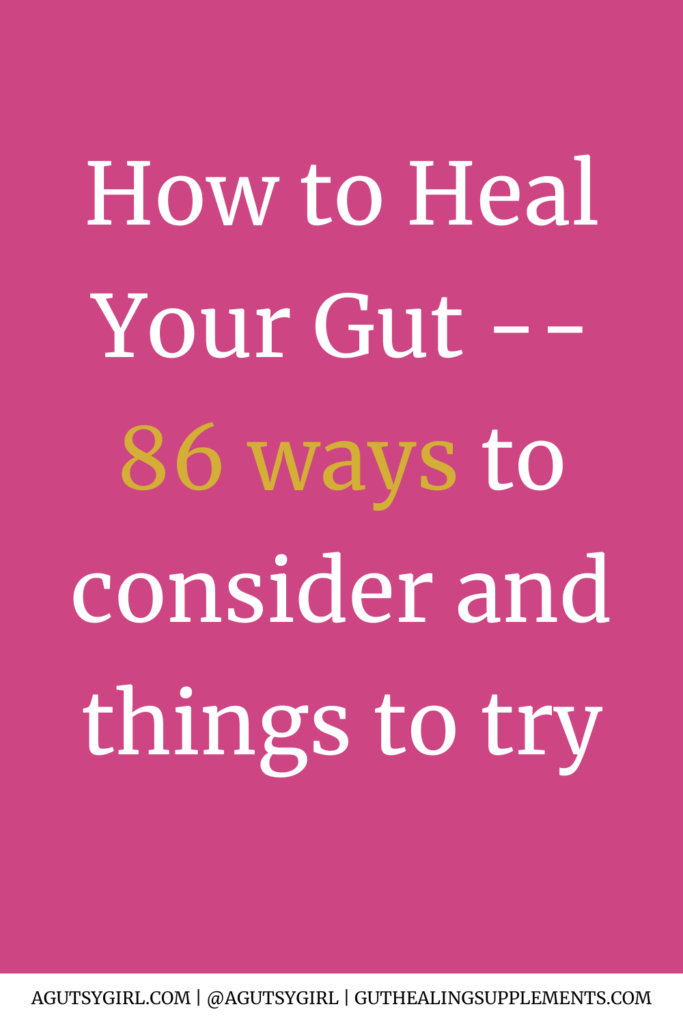
We spent a lot of time putting together this massive list.
And yes, there are actually 86 things on the list.
But not only did we spend a lot of time on the list, we also spent time turning it into a useable sheet for you to take action on.
You can download it right now and skip the rest of this post, if you want.
There are 6 sheets via one PDF download:
- The main sheet with all 86 ways to view/hang up/bind wherever you’ll be able to see it often.
- A sheet that’s more for viewing online, as it links to places for more context and information.
- 4 pages of the information from page 1, broken down so that you can use it for your OWN journey. You can print it then cross off the things you’ve done and/or make notes next to the ones you want to try and/or have further questions on. Process of elimination?!
Ways to Heal the Gut
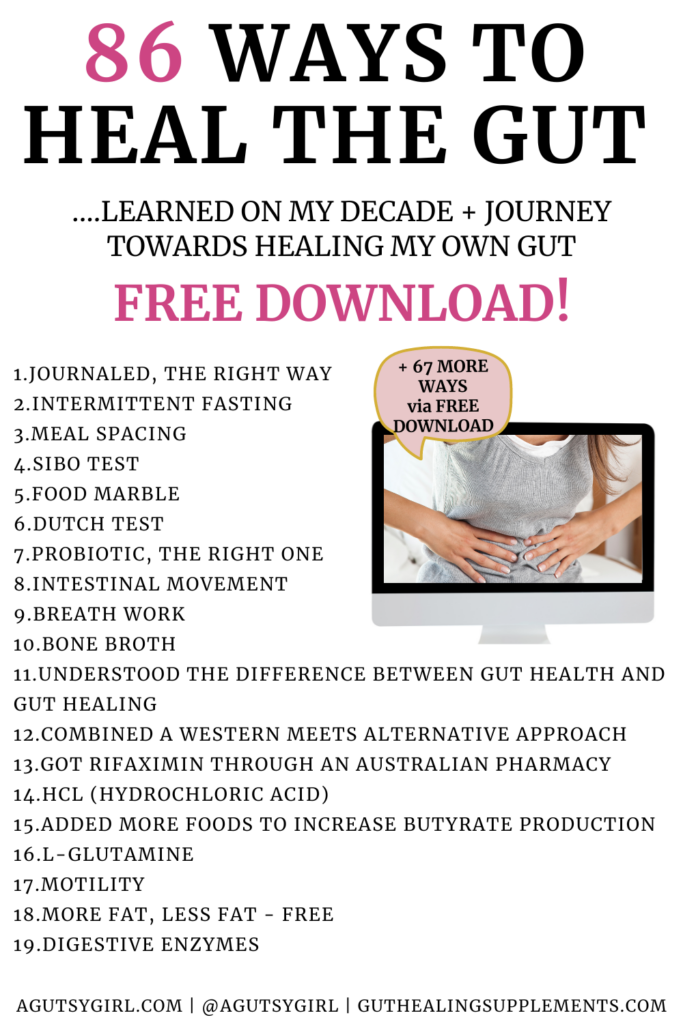
19 of the 86 Ways to Heal Your Gut
- Journaled, the right way
- Intermittent Fasting
- Meal spacing
- SIBO test
- FoodMarble
- Dutch test
- Probiotic, the right one
- Intestinal movement
- Breath work
- Bone Broth
- Understood difference between gut health and gut healing
- Combined a Western meets alternative approach
- Got Rifaximin through an Australian pharmacy
- HCl (Hydrochloric Acid) for low stomach acid
- Added more foods to increase butyrate production
- L-glutamine
- Motility
- More fat, less fat-free
- Digestive enzymes
Each of these has context, nuance, and works differently depending on your root cause.
How to Use the 86 Ways (Without Doing All 86)
Here’s the biggest mistake I see:
Women try 12 things at once.
Don’t.
Instead:
- Identify your biggest symptom.
- Strengthen foundations first.
- Layer in one targeted support at a time.
- Track what changes.
For example:
- If bloating after meals is dominant → explore stomach acid.
- If constipation dominates → focus on motility.
- If weight gain + inflammation is primary → look deeper at gut inflammation patterns.
Start Here: A Simple Path Based on Your Symptoms

If you’re unsure where to begin, here’s a simplified roadmap:
If You’re Mostly Bloated After Meals
Start by assessing:
- Stomach acid levels
- Meal spacing
- Chewing habits
Many women discover their issue isn’t “too much acid” — it’s not enough.
If Constipation Is Your Primary Symptom
Prioritize:
- Motility support
- Hydration
- Nervous system regulation
- Gentle magnesium support (if tolerated)
Without consistent movement, bacteria can overgrow and symptoms compound.
If Reflux Is Your Main Concern
Before suppressing acid long-term, explore:
- Whether digestion is incomplete
- Pressure buildup from fermentation
- Underlying low stomach acid
If Weight Gain + Inflammation Feel Dominant
Look beyond calories.
Gut inflammation can:
- Disrupt hunger hormones
- Increase water retention
- Alter microbiome balance
- Impact insulin sensitivity
Understanding that connection can change your entire approach.
Also read: Will I Lose Weight After SIBO Treatment?
Healing Is Not Linear
One of the biggest misconceptions about gut healing is that progress moves in a straight line.
It doesn’t.
You might:
- Improve for two weeks
- Experience a flare
- Adjust something small
- Feel dramatically better
- Then plateau
This does not mean you failed. It’s simply the Circle of Healing.
It means your body is recalibrating.
Consistency matters more than speed.
This is why tracking patterns — not obsessing over single days — changes everything.
Why I Created the Full 86-Item Guide
Over the last two decades, I kept adding to this list.
I wasn’t sure what I’d do with it until I realized something:
Women don’t need more generic advice. They need options.
The full downloadable guide includes:
- All 86 ways
- A way for you to take notes + explore each item
You don’t need all 86.
You need the right 3–5 for your season.
You can now listen in to the detail for numbers 1 – 4 from above.
If you enjoy listening to all 86 broken down into more detail, they can all be found on the YouTube channel.
Each video contains 4 of the 86 things.
Yes, took me forever to put this altogether.
I truly hope you love this brand new (free) resource!
FAQ: How to Heal Your Gut
Gut healing timelines vary depending on your root cause, stress levels, and consistency. Some women notice improvement within 2–4 weeks, while deeper digestive imbalances can take several months. A structured approach like The Structured Gut Method™ helps reduce guesswork and speed progress.
Early signs often include less bloating, more regular bowel movements, steadier energy, improved mood, and fewer food reactions. Progress is rarely perfectly linear—but consistent symptom reduction over time is the key signal.
Yes. Chronic stress impacts stomach acid production, motility, and the gut microbiome. If your nervous system is constantly in fight-or-flight mode, digestion slows. Gut healing requires both physical and nervous system support.
Low stomach acid is more common than many women realize—especially over 35. Symptoms like bloating after meals, reflux, heaviness, and nutrient deficiencies can all point toward hypochlorhydria. Learn more in The Ultimate Guide to Low Stomach Acid for Women.
Most women benefit from starting with foundational habits—meal timing, hydration, stress reduction, and sleep—before layering in supplements. Supplements work best when your digestive foundations are already supported.
Slow down during meals and chew thoroughly. Digestion begins in the brain and mouth. Eating without distractions and chewing well improves stomach acid signaling and can reduce bloating right away.
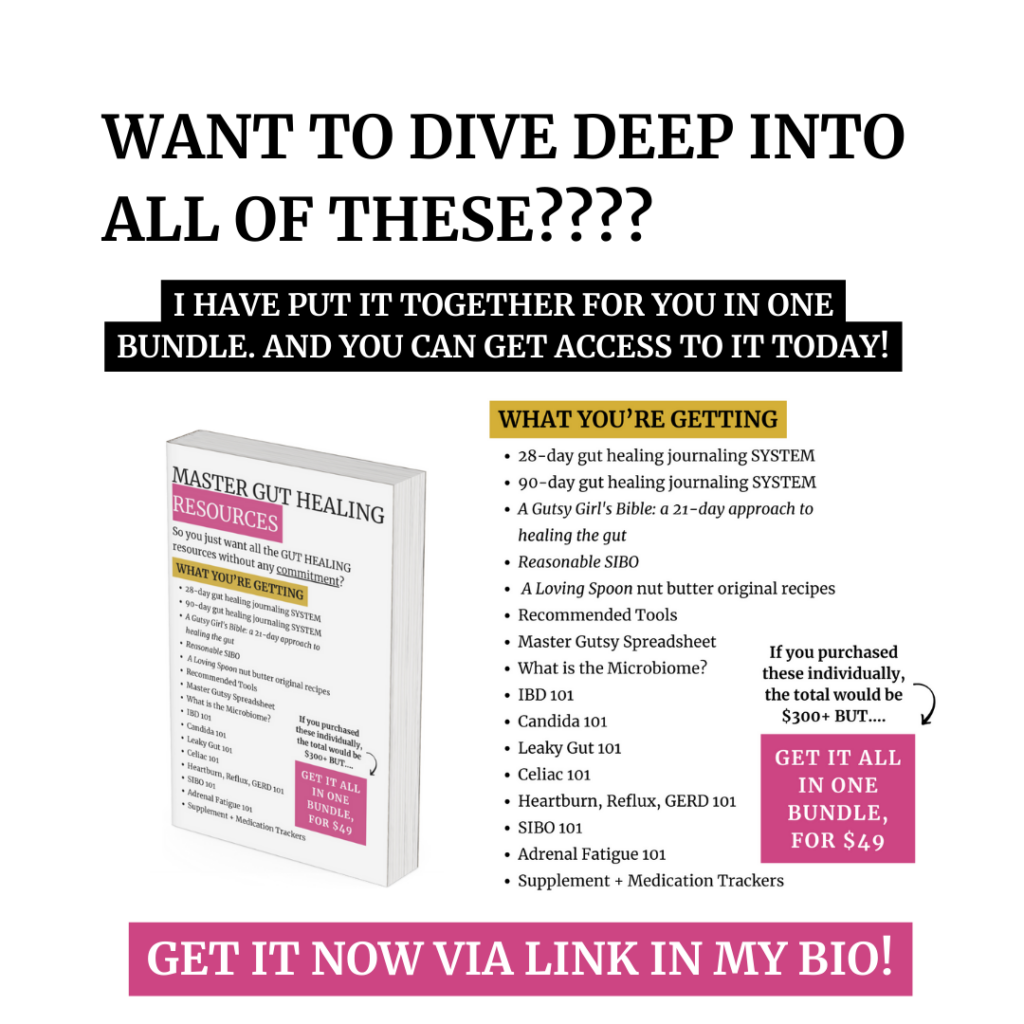
p.s. To learn about all 86 in far more detail, grab my Master Gut Healing Resources!
If you liked this post on how to heal your gut, you might also enjoy:
- How to Heal Your Gut By Addressing These
- Heal Your Gut. Heal Your Life.
- Top 8 Ways to Make Peace with Your Body While Healing Your Gut
Xox,
SKH