

A while back, I wrote about the hormonal symptoms that showed up and made me realize I was in perimenopause.
At the time, I shared what I was feeling, but not my numbers. I wasn’t ready, and I didn’t have the full picture yet.
Now I do. And I can’t believe how much has changed.
So this is the update: my actual labs, exactly what I did over 6 months, and, just as importantly, what I refused to do. As always, this is my personal experience and the plan I built with my doctor based on my labs. I’m sharing what I did, not telling you to copy it. Hormones, medications, supplements, and dosing are deeply individual.
My Perimenopause Update: What 6 Months (and Real Labs) Actually Changed
Click HERE to save this information for later.
My labs, March vs September
Let me show you the actual movement. These are my numbers, from my own lab work, with my lab’s reference ranges (ranges vary by lab, so yours may read differently).
BTW – who actually shares their numbers this transparently? Me. I do. Because I’m trying to prove that you don’t HAVE to be obsessive.
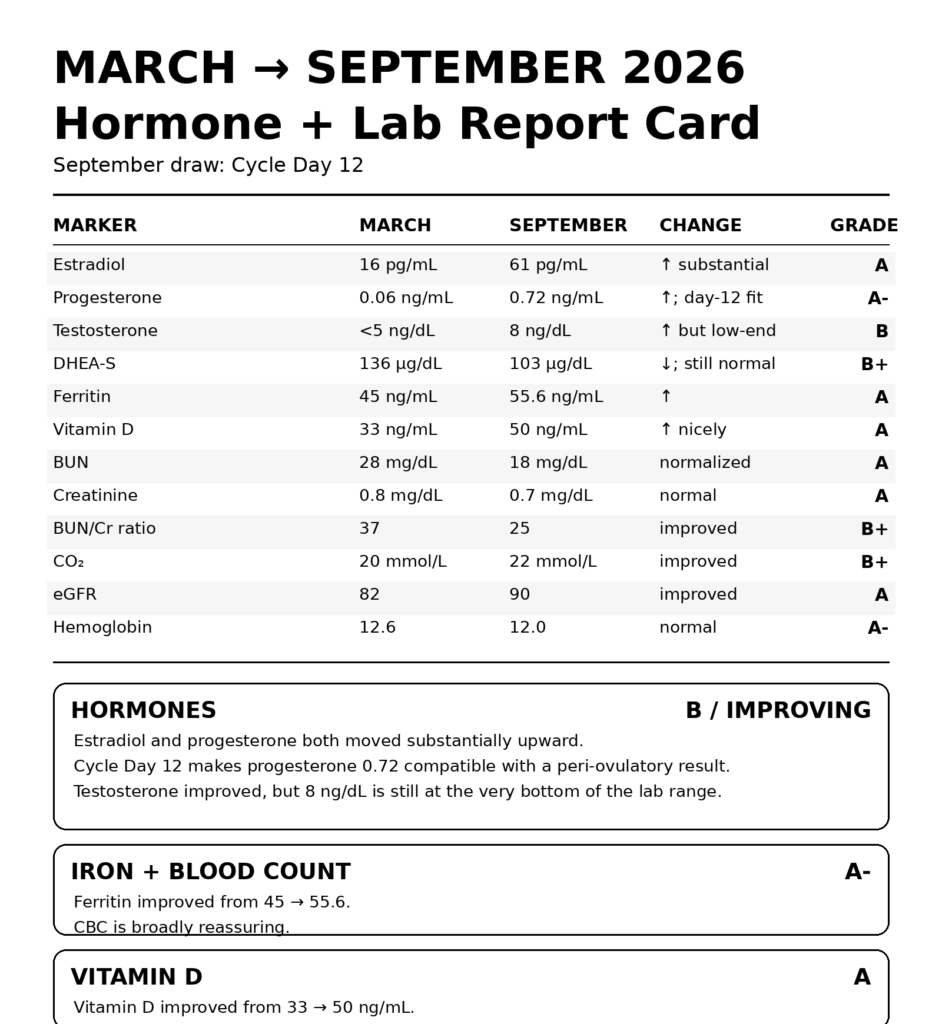
That’s actual movement on paper. My estradiol nearly quadrupled. My progesterone went from barely detectable to solidly in the ovulation-phase range for the day I was tested. Testosterone climbed. And my vitamin D, ferritin, and kidney marker all improved.
One piece of context that matters enormously: I was on Day 12 of my cycle for this draw. That’s why progesterone context is everything. A 0.72 could look low next to a luteal-phase range. But I wasn’t in the luteal phase, and against the ovulation-phase range (0.055 to 4.14), it reads completely differently. Which brings me to a theme of this whole post: women deserve more than a single number stamped HIGH or LOW without anyone asking where they are in their cycle.
So how did I actually do it?
I already know this is the question coming. So let me lay out everything, in more detail than I’ve shared anywhere.
There wasn’t one magic thing. There were several things I changed, consistently, over time.
I shared these things in my original Perimenopause article back in March. Go read it now. In addition to the below, those are things I said I’d do. And I did. Consistently.
And 7 more for you today…..
1. I got a good doctor involved
This was the most important step, full stop.
I worked with Dr. Jeffrey Kotulski at Between the Bridges Healing Center in Minnesota. I had actual bloodwork. We looked at actual numbers. Then we treated my body, instead of guessing based on what someone on Instagram said a 43-year-old woman “should” be doing.
Part of that included compounded hormone support: estrogen, progesterone, and testosterone. The exact ones I take daily include:
- Testosterone from a compounding pharmacy
- Bi-Est from Quicksilver Scientific
- Progesterone+ from Quicksilver Scientific
[You can get both products from Quicksilver through my Fullscript Online Dispensary.]
A Gutsy Girl’s Fullscript Online Dispensary
Shop My Entire DispensaryInstant 20% Savings
And we monitored what happened, which is the part that matters most. Hormone therapy shouldn’t be “take something, assume it’s working, keep taking it forever.” It should be test, treat, observe, retest. That loop is the whole thing.
If you take nothing else from this post: find someone willing to read your labs, your symptoms, your age, your cycle, and your history, together. That person is worth more than any protocol.
2. I got serious about what I put ON my body
For years, my health focus was on what I put in my body. Food, supplements, gut health. Then I started paying attention to what I put on it all day: makeup, skincare, body products, laundry, cleaning products, fragrance. The things I touched, inhaled, rubbed into my skin, and slept in. I replaced the ones I didn’t want in my routine with ones I felt better about.
Let me be very clear, because I won’t overclaim: I cannot tell you that switching my makeup raised my estrogen, or that my laundry detergent changed my progesterone. These labs don’t prove that, and I’m not going to pretend they do.
What I can tell you is this: I stopped wanting to work on my hormones with my doctor while ignoring every other exposure in my environment. I wanted my actions to line up with my goal. This is, quite literally, why I wrote, Toxic Skincare and Gut Health: Why What Touches Your Skin Doesn’t Stay There. [<- read that!]
3. I stopped expecting supplements to do all the work
Yes, I use supplements [ones for both hormones and gut]. Yes, I’m using hormones under my doctor’s care. But none of it works well if the rest of your life is fighting against it.
So I got intentional about the boring things. Eating enough. Eating protein. Lifting. Walking. Getting outside. Sleeping. Recovering.
This part gets wildly underestimated, because none of it is sexy. There’s no affiliate link for “go to bed.” There’s no viral protocol called “eat enough food and do it again tomorrow.” But that consistency is what moved the needle.
4. I strength train
I don’t annihilate myself in the gym because I don’t believe every workout needs to leave me on the floor.
Also, I lift. I get progressively stronger. And I simply walk. Then I recover. I’m far more interested in building and preserving muscle than in making my body smaller. At 43, that feels like the better long-term investment, for my bones, my metabolism, and my next 40 years. Strength training is one of the most consistently recommended tools for women in perimenopause, and it’s one I actually enjoy.
I still do everything I preached via Weight Lifting Workouts for Women Over 40.
5. I pay attention to my cycle
I said it above and I’ll say it again here, because it’s that important. A hormone result without cycle context tells a completely different story.
My September progesterone is the perfect example. Compared to a luteal-phase range, you might decide something was wrong. But I was on Day 12. Tracking where I am in my cycle has changed how I read my own body and how I talk to my doctor.
I track my cycle with the simple ‘Health’ apple app. It’s free.
6. I test, I change things, and I test again
This might be the real secret.
I had March numbers. I changed things. Six months passed. I got September numbers. Some things improved dramatically, some moved a little, some still need work, and a couple of new questions appeared.
That’s health. It isn’t “find the one root cause and you’re done.” It’s pay attention, gather information, make changes, give them time, retest, ask better questions. Over and over.
7. I stopped treating my body as separate issues
This might be the biggest shift of all.
I’ve spent a huge portion of my life looking at everything through the gut-health lens. I still care deeply about gut health. Hello, I’m A Gutsy Girl.
But my gut isn’t floating in a separate container from the rest of me. My hormones matter. My muscle matters. Minerals matter. Sleep, stress, environment, food, relationships, and nervous system matters. It’s all one body.
These days I’m less focused on “what’s wrong with me?” and more interested in “what does my body need from me today?”
Now, here’s what I do NOT do
This might be the most important part of the whole post.
Spend any time online in the women’s health, perimenopause, or fitness world and you can quickly start believing that getting healthy at this age requires an advanced degree. Microdose this. Track that. Weigh this. Calculate that. Time it exactly. Buy the wearable, the supplement, the program. Optimize, optimize, optimize.
I’m not doing it.
I am not weighing every bite on a food scale.
I am not counting calories or obsessively tracking macros.
I am not cutting entire macronutrient categories because someone named today’s villain.
I am not fasting myself into the ground.
I am not chasing a six-pack.
I am not working out twice a day.
I am not biohacking every waking hour.
And I am not buying the idea that health has to become my full-time job for my body to respond.
None of it. And my labs still moved.
This isn’t me saying there’s never a place for medication. It’s not me saying tracking is bad, or that another woman’s protocol is wrong for her. I’m saying something simpler: those things are not prerequisites for getting healthier.
I didn’t need a more complicated life. I needed a good doctor. Real labs. Someone willing to look at my numbers, my symptoms, my age, my cycle, and my history.
Take the things I said I’d take. Lift. Walk. Eat. Sleep. Swap the products I wanted out. Pay attention to my cycle. Keep the appointments. Get the blood draw. Wait. And do it all again tomorrow.
No viral protocol. Or miracle. No 7-day reset. Just honest, daily consistency long enough to finally see it reflected back on a piece of paper.
What I most want you to take from this
Before assuming your body needs something more extreme, make sure you’ve given it the basics, consistently, personally, and with the help of someone who knows how to read your labs.
Sometimes the answer isn’t another hack. Sometimes it’s good medicine, good information, enough time, and doing the boring things over and over.
And right now? I’m pretty freaking proud of what my body is doing. In fact, I can’t believe the mountains I’ve moved in just 6 months.
Xox,
SKH
This is my personal experience and the plan I built with my doctor based on my own labs. Hormones, medications, supplements, and dosing are highly individual. I’m sharing what I did, not telling you to copy my protocol. Please work with your own qualified provider.
Frequently asked questions
Perimenopause journey FAQ
Why does cycle day matter when testing hormones?
Hormone levels, especially progesterone, change dramatically across your cycle. A result that looks low against a luteal-phase range can be completely normal for the ovulation phase. Without knowing what cycle day a sample was drawn, a single number can be badly misread. Always note where you are in your cycle.
Do you have to do extreme protocols to improve your labs in perimenopause?
Not in my experience. My numbers moved over 6 months without GLP-1 microdosing, calorie counting, extreme fasting, or two-a-day workouts. What worked was a good doctor, real labs, hormone support under medical care, strength training, and consistency with the basics. Your path should be built with your own provider.
Is hormone therapy right for perimenopause?
That’s a decision only you and a qualified provider can make, based on your labs, symptoms, history, and risks. What mattered in my case wasn’t just taking hormones, it was the test-treat-observe-retest loop that let us see whether it was actually working. I’m sharing my experience, not a recommendation.
Find your next step
One question. A specific plan for where you are right now.
I'm Sarah Kay Hoffman.
20 years with SIBO and IBS. 1,000+ articles written on digestion. A supplement line I formulated myself.
I built The Structured Gut Method™ because I watched thousands of women cycle through the same 4 steps: restrict, feel better, plateau, restart.
Answer one question and I'll tell you where to start.
What do you need right now?


